
Founder-led advertising: turn expertise into source-backed ad angles
SOURCE-TO-ANGLE BUILDER
Review one source-backed angle
This form reviews one selected angle. It does not create the full shortlist or scene plan.
No selected angle yetAdd a buyer problem and proposed hook.
Source: not set
Next:
Route: review one angle here. For a full handoff, run the build prompt with the blank JSON, then import it.
Next action:
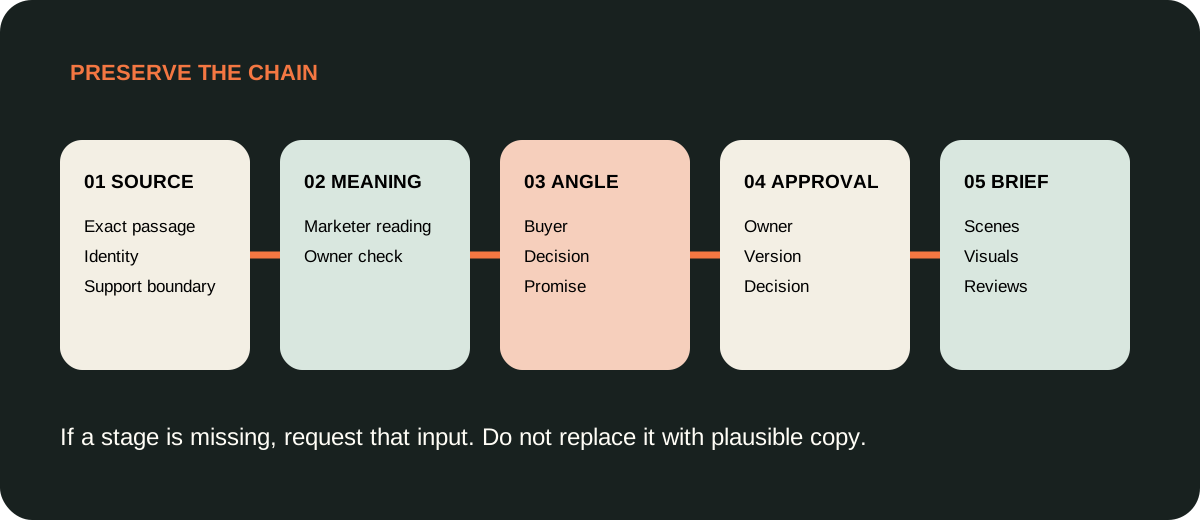
Founder-led advertising starts with something the founder actually knows and believes. Capture that material before planning the shoot.
Use this sequence:
- Choose one buyer problem.
- Interview the founder for an argument, example, objection and proof boundary.
- Save the exact passages that support each idea.
- Separate what the founder said from what the marketer thinks it means.
- Choose distinct angles and send them to the right owner for approval.
- Turn one approved angle into a recording and editing brief.
The source-to-angle builder on this page keeps those six steps connected. Add the source passage first. It will hold an angle when the passage, interpretation, approval owner or approval state is missing.
What is founder-led marketing?
Founder-led marketing uses a founder's experience, decisions and point of view as marketing source material. That can become a post, interview, event, ad, video or sales resource.
The founder does not need to become a full-time creator. They do need to supply something the marketing team cannot make up for them: a real belief, story, decision or explanation.
A good topic sits close to the product and the buyer's work. It does not have to pitch the product. In a The B2B Playbook interview, Adam Holmgren recommends choosing clear content pillars that relate to the product while leaving room to share a point of view. That is a sensible way to choose interview territory. It is practitioner advice, not a performance rule.
Founder-led marketing is a poor fit when:
- the founder does not want to be the public source;
- marketing needs to invent or heavily rewrite the founder's position;
- the topic belongs to a customer, practitioner or product expert instead;
- the team cannot name the approval owner;
- the plan depends on claims that nobody can support.
Use the person closest to the knowledge. The right source may be a founder, operator, customer or partner.
Start with one buyer problem
Do not start the interview with “What should we post about?” That question asks the founder to do the marketer's job while thinking on the spot.
Bring one buyer problem instead. Write down:
- Buyer: the person who needs to recognize the problem.
- Situation: what is happening when the problem becomes visible.
- Decision: what the buyer needs to choose, change or understand.
- Founder connection: why this founder has firsthand knowledge of it.
- Proof boundary: what the founder can support and what still needs another source.
For example, a founder who has rebuilt a slow approval process can speak about why decisions stall, what they changed and what surprised them. A founder who merely sells workflow software should not pretend they ran the buyer's process.
The output of this step is one sentence:
We are interviewing [founder] about [buyer problem] because they personally [experience or decision], and the buyer needs help deciding [specific choice].
If you cannot complete that sentence honestly, change the topic or change the source.
Run a focused founder interview
Plan the interview around the buyer problem. A broad conversation about the founder's journey makes the relevant passages harder to find. Send the topic and purpose before the call. Record only with permission. Tell the founder how the material may be used and who will review it.
Before the interview
Prepare these fields:
- Buyer and problem.
- One decision you want the founder to explain.
- The founder's relationship to that decision.
- Known facts and available proof.
- Claims or topics that are off limits.
- Recording, quotation and publication permission.
- Approval owner and deadline.
During the interview
Ask for one point at a time.
Find the belief
- What do people in this market usually get wrong about this problem?
- What do you believe instead?
- What changed your mind?
Find the decision
- Tell me about a time you had to make this choice.
- What options did you reject?
- What did you notice that other people missed?
Find the example
- What did the process look like before?
- What changed in the actual work?
- Can you give me a specific moment, handoff or artifact?
Find the objection
- What would a sensible buyer disagree with here?
- When would your recommendation be wrong?
- What would you need to see before changing your view?
Find the proof boundary
- Which parts did you observe yourself?
- Which numbers, customer statements or results need another source?
- What should we ask someone else to confirm?
Follow a vague answer with “What did that look like?” Follow a conclusion with “What happened that made you think that?” The goal is not a dramatic quote. The goal is a passage another person can understand without the marketer filling in the missing logic.
Save passages before you write hooks
After the interview, create one source record for every passage you may use. Each record needs:
- source name and source type;
- speaker and their relationship to the topic;
- date or recording ID;
- exact passage or timestamp;
- public, private or permission-limited status;
- what the passage can support;
- what it cannot support;
- approval owner and current state.
Then classify the next line you write.
| State | What it means | What you can do |
|---|---|---|
| Founder claim | The passage states this point directly. | Quote or paraphrase it with the source attached. |
| Marketer interpretation | Marketing drew a conclusion from the passage. | Label it as an interpretation and ask for approval. |
| Hypothetical copy | This is proposed wording for an angle or hook. | Keep it in draft until the owner approves it. |
| Unresolved question | The source does not answer the point yet. | Ask a focused follow-up. Do not fill the gap. |
These states cannot collapse into one text box. If the founder says “We removed two approval steps,” marketing cannot silently turn that into “Most approval processes are broken.” The second sentence is a broader claim and needs its own support or approval.
Worked example: Dylan Field, Jeetu Patel and Figma
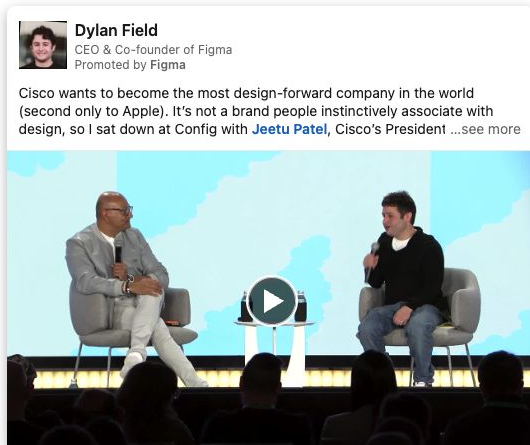
SELECTABLE PUBLIC WORDING
Source: LinkedIn Ad Library 1499184766
“The people closest to the work should present it.”
“When Jeetu started design reviews at Cisco, teams were presenting to their VP, then their SVP, then their SVP’s boss. It took six weeks for a design review to show up on his calendar, so he reworked the process. ICs started presenting directly to execs.”
The six-week account comes from the post. It does not appear in the copied machine transcript of the video.
See the public sponsored post. Figma sponsored a video post by CEO and co-founder Dylan Field about his Config interview with Cisco President and Chief Product Officer Jeetu Patel.
Field's public post includes this principle:
“The people closest to the work should present it.”
It also includes the process behind it:
“When Jeetu started design reviews at Cisco, teams were presenting to their VP, then their SVP, then their SVP’s boss. It took six weeks for a design review to show up on his calendar, so he reworked the process. ICs started presenting directly to execs.”
The post supports an observation: Field says Patel changed the review path after a six-week chain through management layers.
Marketing can make an interpretation from that passage: a decision bottleneck is a more concrete topic than a broad claim about design leadership. That interpretation is not a new Patel or Field quote.
Here are three different angle directions:
- Frontline authority: Who should present the work?
- The six-week review chain: What changed when the review path lost its management layers?
- Culture through process: How does the way work gets reviewed affect attention to craft?
The first angle is about the speaker. The second is about latency. The third is about the relationship between process and culture. Three hooks that all say “let the people closest to the work present” would still be one angle.
The video shows Field and Patel in an on-stage interview. Its machine transcript covers design influence, adoption and commercial relevance. It does not contain the six-week review-chain account above. That account belongs to Field's post. Keep the sources separate.
This example shows the transformation. It does not prove that the post or ad performed well, reveal Figma's private interview process or grant approval for new copy.
Choose materially different ad angles
An angle is the decision the ad asks the audience to inspect. Changing only the opening sentence keeps the same angle.
Build three to five candidates from different parts of the source:
- Belief: the founder's clear position.
- Mistake: the common approach they reject.
- Decision: a choice they made and why.
- Process: a sequence, handoff or operating change.
- Example: a specific moment that makes the point concrete.
- Objection: the condition where the advice changes.
Give every candidate an angle ID. Compare the buyer, problem, decision and promised lesson. Merge two candidates when those four fields are the same, even if the wording differs.
Reject an angle when:
- it has no exact source passage;
- it turns an interpretation into the founder's words;
- it depends on an unverified result;
- it repeats another angle's promise;
- the source owner is unknown;
- the founder would need to discover the point while recording.
Keep a small list where each option gives production a different ad to make.
Get approval without losing the source
Approval is attached to a specific angle and wording. It is not a general “the founder is okay with marketing.”
For each shortlisted angle, send the owner:
- the exact source passage;
- marketing's interpretation;
- proposed hook and supporting point;
- facts or proof that will appear;
- anything still unresolved;
- intended format and destination;
- the decision you need: approve, revise or reject.
Record the approver's name, decision, date and version. Silence stays Pending. A previous approval does not automatically cover changed wording.
If the founder approves the idea but rewrites the point, save the new approved wording beside the original source. Do not overwrite the source passage. That record explains what changed and prevents an old draft from reappearing later.
Turn one approved angle into a recording brief
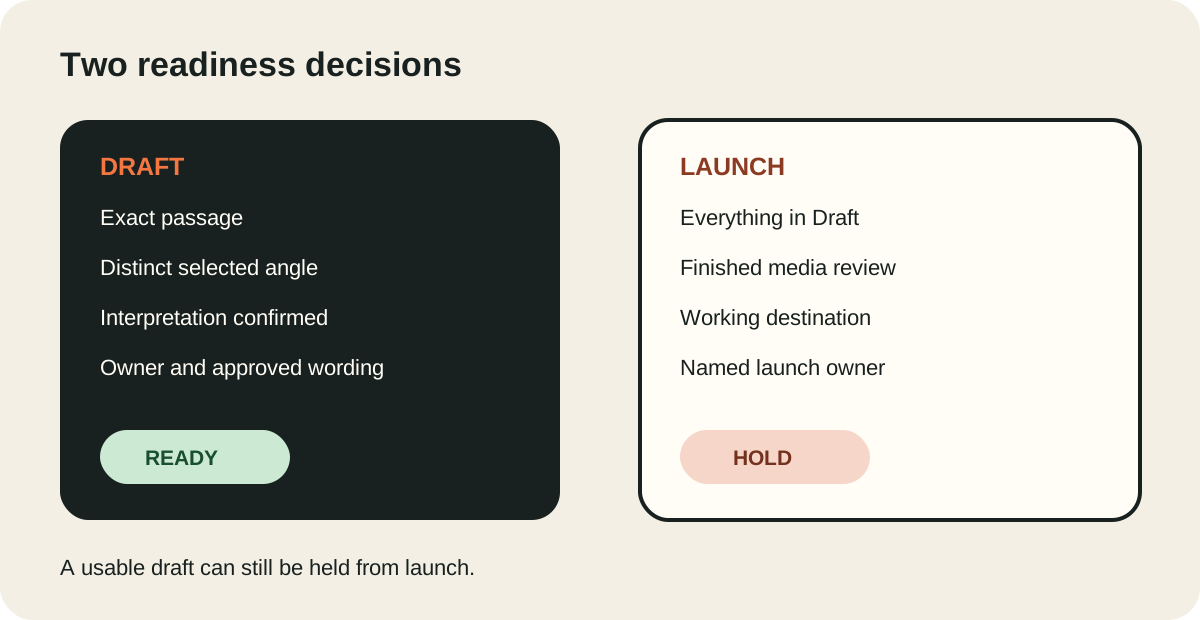
The recording brief should let the founder and editor make the same ad without a private explanation from the marketer.
Message
- Buyer and situation.
- Approved angle ID and one-sentence point.
- Exact source passage.
- Approved spoken words, or clear notes where natural delivery is allowed.
- Claims that must not be added.
- One next action and real destination.
Recording
- Speaker and their relationship to the topic.
- Framing, orientation and target length.
- Where the speaker should look.
- Delivery note for each section.
- Required demonstration, object or screen.
- Room, sound and lighting requirements.
Edit
- Scene order and approximate duration.
- Exact on-screen text.
- Captions and speaker identification.
- Supporting screenshots, product footage or documents.
- Words or claims the editor cannot introduce.
- Required aspect-ratio versions.
Review
- Founder or source owner.
- Product or factual reviewer.
- Brand or legal reviewer when needed.
- Approval deadline.
- Final destination and launch owner.
A recording brief is Hold when the source passage, approval owner, final claim wording or real destination is missing. The team can still plan framing and scenes. It cannot call the ad ready to record or launch.
Three source mechanisms to study
The best source depends on the point you need to make.
Interview synthesis: Figma
Field's post turns an interview into three lessons and preserves a process detail for the first one. Use this mechanism when the founder can ask another expert about a decision and explain what stood out. Keep the guest's words and the founder's interpretation separate.
First-person story: Pinterest Business
See Stacy Wright Malone's sponsored post. Malone describes searching Pinterest for her son's birthday ideas and leaving with a party theme, decorations and gifts. The story makes the planning-to-buying sequence concrete.
Use this mechanism when the speaker personally lived the situation. Do not borrow the story shape and then invent a founder anecdote. The post's purchase-likelihood statistic is Pinterest's claim and is not evidence for another company.
Edited customer voice: ZoomInfo
See Henry Schuck's sponsored post. The post combines vendor framing, growth claims and short customer statements in one video package.
This mechanism needs tighter records. Save each speaker, exact passage, relationship to the product and permission separately. Keep vendor narration out of the customer's mouth. The public record does not establish the speakers' identities, approval terms or typical results, so those details cannot be inferred.
Use the source-to-angle builder
Choose one of the two routes at the top of the builder.
For a quick single-angle review, start a clean record in the browser. Add the source identity, exact passage, support boundary, interpretation and one source-linked angle. Assign the approval owner, record the decision and export the review record.
For a complete recording handoff, download the blank JSON and build prompt. Give the prompt your source material and interview plan in an AI assistant. It creates up to five angle candidates, compares duplicates, selects an angle and fills the scene, delivery, visual, reviewer and claim-boundary fields. Save the returned JSON and import it into the builder. The browser shows the selected angle and recomputes Draft and Launch readiness from the complete record.
Export the handoff as Markdown and JSON. Reopen the JSON and confirm that the source, candidates, selected angle, brief, approval and unresolved requests are unchanged.
The builder should return a specific action for each problem:
- Missing passage: add the exact passage or timestamp.
- Ambiguous interpretation: ask the source owner whether the interpretation is fair.
- Missing owner: name the person who can approve the claim.
- Duplicate angle: merge the candidates or change the decision being examined.
- Missing destination: keep production planning provisional and block launch readiness.
Do not replace every problem with “needs review.” The person using the handoff needs to know what to ask and who should answer.
What happens after the recording brief?
This page ends when the source-backed angle and recording brief are ready for production.
- Use the LinkedIn Thought Leader Ads guide when you have a real person's post and need consent, sponsorship, launch and measurement steps.
- Use the LinkedIn Video Ad Examples when you need channel-specific video examples and production choices.
- Use the Facebook Video Ad Examples when you need Meta examples, placements and adaptation guidance.
- Browse all resources when the next job is different.
Founder-led advertising questions
Does the founder need to write the ad?
No. A marketer can draft the angle and brief. The founder needs to supply or approve the point of view, examples and final wording attributed to them.
Can we use an old podcast, post or sales call?
Yes, when you have the right to use it and can preserve the exact passage. Record the source and permission. A private sales call does not become public material because the transcript is convenient.
How many angles should one interview produce?
There is no fixed number. Aim for three to five distinct candidates from different decisions or source moments. Merge paraphrases. One strong approved angle is better than ten unsupported hooks.
What if the founder gives a good idea with no proof?
Save it as a founder belief or unresolved question. Remove the unsupported result, find another source or ask what evidence would change the claim. Do not invent a customer, number or case study.
What if the founder changes their mind during review?
Keep the original passage and save the approved revision as a new version. The final brief should point to the approved version and record who changed it.
When is the brief ready to record?
The selected angle, source passage, spoken claim, approval owner and review state must be present. Recording logistics can remain adjustable. Missing claim or ownership fields keep the brief on hold.
Download the source-to-angle kit
The builder and downloads use the same field contract. JSON exports can be reimported without losing the exact passage, interpretation, approval state or unresolved requests.
Copy the build prompt
Build a source-linked founder-led advertising handoff. Work only from the supplied inputs. Do not invent a founder belief, quotation, source, result, customer, approval, owner, destination or performance claim.

REFERENCE MECHANISM
Figma sponsored Dylan Field's public video post about his interview with Jeetu Patel: https://www.linkedin.com/ad-library/detail/1499184766. The post states, “The people closest to the work should present it.” It also says a Cisco design review once moved through VP and SVP layers and took six weeks to reach Patel, after which individual contributors began presenting directly to executives. A marketer can derive angles about who presents, review latency or culture through process. Those interpretations are not new Field or Patel quotations and still require approval. The public record does not prove campaign results or reveal the private interview process. Use this only as a structure example; do not copy its wording into the user's handoff.

REQUIRED INPUTS
1. Buyer and buyer problem.
2. Source ID, type, speaker, speaker's relationship, date or recording ID, exact passage or timestamp, and URL or controlled reference.
3. Publication/permission state: public, private, permission-limited or unknown.
4. What the passage supports and does not support.
5. Marketer interpretation.
6. Three to five proposed angles, if available.
7. Approval owner and current state: pending, approved, revise or rejected.
8. Intended format, speaker, required visual or demonstration, and prohibited claims.
9. Destination URL, CTA and launch owner if launch readiness is being assessed.

STATE RULES
- Keep `source_passage`, `marketer_interpretation`, `proposed_copy`, `approval_state`, `approval_owner` and `unresolved_requests` separate.
- `source_passage` must be exact supplied text or a supplied timestamp. Never reconstruct a missing passage.
- Silence and unknown status mean `pending`, never `approved`.
- A marketer interpretation cannot be returned as the speaker's words.
- An angle without an exact passage is `hold_missing_source`.
- An interpretation that could materially change the speaker's meaning is `hold_ambiguous_interpretation` with a focused question for the source owner.
- An angle with no approval owner is `hold_missing_owner`.
- Candidate angles with the same buyer, problem, decision and promise are duplicates. Merge them under one angle ID and return `merge_duplicate_angle`.
- Draft readiness requires an exact source passage, a materially distinct selected angle, an approval owner and an explicit approval state. Approval may still be pending, but the output must remain Hold until approved final wording exists.
- Launch readiness also requires finished-media review, required factual/brand reviews, a working destination and a launch owner.
- A missing destination can allow provisional production planning. It always blocks launch readiness.

OUTPUT CONTRACT
Return one JSON object. Do not wrap it in Markdown. Set `schema_version` to the exact literal `maestro.founder-source-to-angle.v1`. Use these top-level keys exactly:
`schema_version`, `record_id`, `record_owner`, `source_record`, `interpretation`, `angles`, `selected_angle_id`, `approval`, `recording_brief`, `unresolved_requests`, `draft_readiness`, `launch_readiness`.

Use JSON null for an unavailable scalar. Do not use an empty object, array, placeholder string or freeform prose where the field types below require something else.

- `record_id`: string or null. `record_owner`: string or null. `selected_angle_id`: string or null. A non-null value must match one `angles[].angle_id`. When no angle can safely be selected yet, keep the candidate `angles`, set `selected_angle_id` to null, add a focused selection request, and keep Draft and Launch on Hold.
- `source_record`: an object with `source_id`, `source_type`, `speaker`, `speaker_relationship`, `source_date_or_id`, `source_passage`, `source_url_or_reference`, `permission_state`, `supports`, `does_not_support`. Every value is string or null. `permission_state` is one of `public`, `private`, `permission-limited`, `unknown`.
- `interpretation`: an object, never a string. It has `text` (string or null) and `state` (exactly one of `unreviewed`, `confirmed_by_source_owner`, `revised_and_confirmed`).
- `angles`: an array of objects. Each item has `angle_id`, `label`, `buyer`, `problem`, `decision`, `promise`, `proposed_hook`, `basis`, `state`, `duplicate_of`, `required_action`. Text fields are string or null. `basis` is exactly one of `exact_passage`, `interpretation`, `confirmed_interpretation`; use `exact_passage` only when the proposed hook stays within the supplied passage, `interpretation` when it needs unconfirmed interpretation, and `confirmed_interpretation` only when that interpretation is explicitly confirmed. `state` is one of `candidate`, `selected`, `duplicate`, `rejected`. `duplicate_of` and `required_action` are string or null.
- `approval`: an object with `owner`, `approved_version_id`, `approved_hook`, `approved_supporting_point`, `decision_date`, `required_action` as string or null. `state` is exactly one of `pending`, `approved`, `revise`, `rejected`. Unknown or silent approval becomes `pending`.
- `recording_brief`: an object. `speaker`, `format`, `orientation`, `delivery`, `required_visual`, `destination_url`, `cta`, `launch_owner` are string or null. `target_duration_seconds` is a positive number or null. `prohibited_claims` and `reviewers` are arrays of strings. `finished_media_review` is exactly `not_run` or `passed`. `scenes` is an array of objects. Each scene has `scene` (positive number), plus `approx_seconds`, `spoken_point`, `on_screen_text`, `required_visual`, `source_or_approval` as string or null.
- `unresolved_requests`: an array of objects. Each item has `code`, `request`, `owner` as string or null and `blocks_draft`, `blocks_launch` as JSON booleans.
  Keep each request until its named prerequisite is actually supplied. Field-derived request codes may be removed only when the corresponding field now passes the contract. A source-permission, meaning, approval or other external request stays in the array until a reviewed JSON update explicitly removes it after resolution; filling an unrelated field never resolves it.
- `draft_readiness` and `launch_readiness`: objects with `state` exactly `Ready` or `Hold`, `reasons` as an array of strings, and `next_action` as string or null.

If inputs are missing, ask no more than three focused questions. The three-question limit does not limit `unresolved_requests`: include a separate action row for every missing prerequisite, even if several rows are phrased as direct completion actions instead of questions. Complete the safe parts of the JSON, leave missing scalar values as null, use empty arrays for missing lists, and keep the affected readiness state on Hold. Do not fill gaps with generic copy.
Copy the independent review prompt
Review a source-linked founder-led advertising handoff as an independent editor. You receive only the handoff JSON and the original supplied source inputs. Do not infer private context. Do not rewrite a failed handoff into a passing one.

CHECKS
1. Exact source: every selected angle has an exact supplied passage or timestamp and valid source identity.
2. Meaning: interpretation and proposed copy do not expand, reverse or overstate the speaker's supplied meaning.
3. Distinct angles: compare buyer, problem, decision and promise. Paraphrases count as duplicates.
4. Approval: owner, state, version and approved wording are explicit. Silence is pending. A changed hook needs a new decision.
5. Proof: results, numbers, customers and causal claims have their own source or remain excluded.
6. Recording brief: selected angle, spoken point, on-screen text, visual and prohibited claims agree.
7. Requests: missing source, ambiguous interpretation, missing owner, duplicate angle and missing destination have different action codes and named owners when known.
   On export/reimport, every supplied unresolved request must survive byte-for-byte until its own prerequisite is resolved. Computed checks may be added, but an unrelated field change must not delete a permission, meaning, approval or ownership blocker.
8. Readiness: Draft and Launch are judged separately. Launch needs finished-media review, required reviews, working destination and launch owner.
9. Round trip: source ID, exact passage, interpretation, approval owner/state and unresolved requests must survive export and reimport unchanged. If the original export and reimport artifacts are not supplied, report `roundtrip_check.status` as `not_run`. Do not claim a roundtrip pass from one JSON object.

RETURN
Return one JSON object with keys `verdict`, `findings`, `angle_comparison`, `readiness_check`, `roundtrip_check`, `required_repairs`.

`verdict` is `pass` only when there are no material findings. Otherwise it is `hold`.
Each finding contains `code`, `severity`, `location`, `reader_consequence`, `evidence`, `repair`, `owner`.
`angle_comparison` lists every pair and states `distinct` or `duplicate`, with the exact differing or matching buyer/problem/decision/promise fields.
`readiness_check` gives separate Draft and Launch verdicts and reasons.
`roundtrip_check` names the compared export/import artifacts, values and any mismatch. It contains `status` (`pass`, `fail` or `not_run`).
Do not reward polished wording when provenance, approval or ownership is missing.