
What is demand generation?
Demand generation is marketing that gets a specific audience to understand a problem and prefer your way of solving it, before they are ready to talk to sales. It reaches people who have not raised a hand yet. Lead generation starts when someone does: it captures an identifiable response and begins a follow-up path.
Some teams use demand generation as the umbrella term for all marketing that feeds pipeline, including lead capture. This page separates them as demand creation and demand capture, because they need different owners and measures.
What demand generation includes
| Activity | What it does | Early signal to watch |
|---|---|---|
| Problem-led ads | Show a defined audience a cost or risk it may be underrating | Reach and attention within the intended audience |
| Founder or expert content | Teach a point of view on the problem | Direct replies and return visits |
| Customer stories | Show proof from a buyer in a similar position | Prospects mentioning the story to sales |
| Diagnostic resources without a form | Help a reader size the problem | Use of the resource and return visits |
| Events and webinars | Teach a market and build familiarity | Target accounts attending and the questions they ask |
Any of these can also capture leads. The job decides which motion it belongs to, not the channel.
A B2B demand generation example
Take a fictional company selling leak-detection software to facilities teams. Few facility managers search for it, because they treat water damage as an insurance cost. So the company runs ads and short founder videos on what leaks cost a large building portfolio, and publishes a repair-cost worksheet with no form. That is demand generation. When a facility manager later requests a demo, the form, routing and follow-up are lead generation.
For real ads, see the HubSpot, TeamGantt and UKG video patterns below. They show structure, not ad performance, and TeamGantt's is closer to capture.
How to build a demand generation strategy
- Name one audience you can define and reach.
- Name the problem it underrates, in words taken from sales calls and customers.
- Gather approved proof that the problem and your approach are real.
- Choose an asset and channel: something useful without a form, placed where this audience already pays attention.
- Agree on the next signal and what sales will accept when someone responds.
- Set a review date and owner before you publish.
The planner also asks for your offer, current demand, capture path, sales capacity and owners, then returns a route, and Build the next 90 days turns it into a plan.
How to measure demand generation
Buyers may not respond for months, so a short-term form count will undervalue demand generation. Check in this order: did the intended audience see and use the asset, did direct feedback or branded and problem search change, and did later deals come from the same audience? Add pipeline and revenue when the CRM evidence exists. Keep each outcome state separate so early signals are never reported as pipeline.
The practical difference between demand generation and lead generation
Demand generation answers: Why should this buyer care?
It can use founder expertise, customer language, diagnostic resources, category education, problem-led ads, events or proof. The job is to make a specific audience understand a problem, believe a new approach or remember the company when the problem becomes urgent.
Lead generation answers: What happens when the buyer raises a hand?
It can use high-intent search, demo requests, contact forms, event registration, a calculator or another explicit response. The job is to record the response, preserve its context, qualify it and move it to the right owner.
The difference is the job, not the channel. A video can create demand by explaining a problem. A product video on a high-intent page can help capture an evaluating buyer. A webinar can educate a market, capture registrations or do both. A form does not turn an unready person into qualified pipeline.
| Question | Demand creation | Demand capture |
|---|---|---|
| Buyer state | May not be looking for a solution yet | Has shown an explicit response or intent signal |
| Main job | Build understanding, relevance and preference | Record, route and follow up on intent |
| Typical asset | Problem explanation, founder lesson, customer story, diagnostic guide | Comparison, demo, calculator, form, event registration, high-intent page |
| First evidence that informs the next decision | Qualified audience attention, direct feedback, branded or problem demand, return visits | Identifiable response with source, context and owner |
| Common failure | Publishing content with no audience or next signal | Counting every form fill as a sales-ready lead |
| Handoff | An observed signal opens the next message or capture path | Marketing passes evidence that sales has agreed to accept |
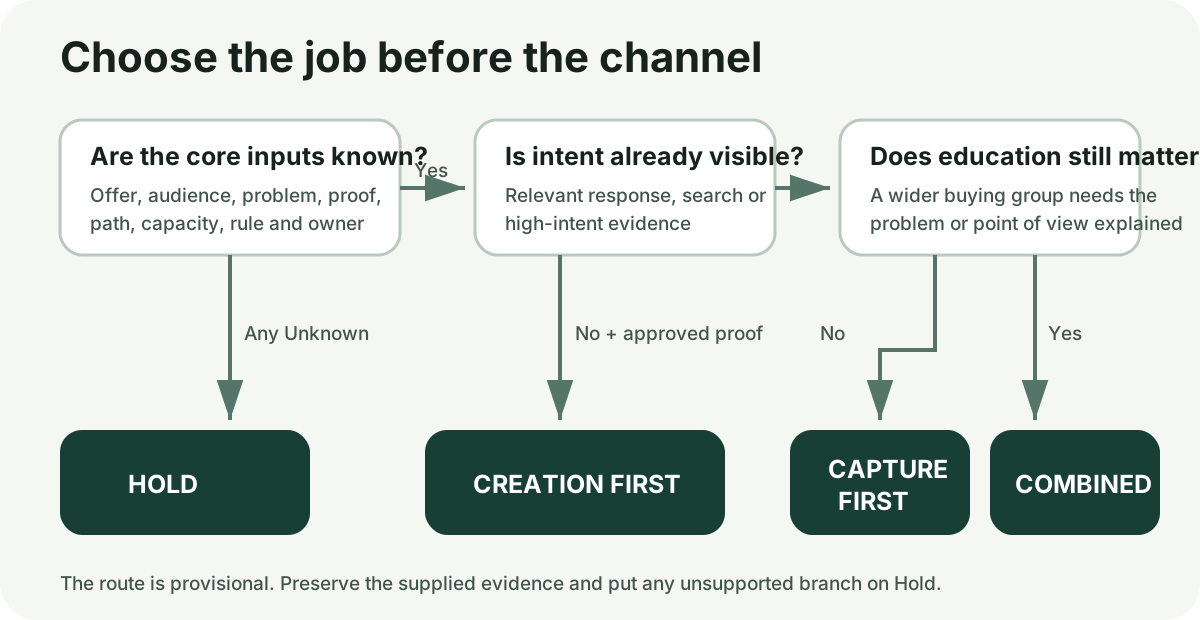
Most B2B teams need both. The real decision is what should carry the next 90 days, what evidence connects the two motions, and what sales will accept when someone responds.
Use the planner on this page to choose one of four routes:
- Creation first: buyers need to understand the problem before they will look for a solution.
- Capture first: relevant intent already exists, but the path from response to sales needs to work.
- Combined: the team has a real education job and a defensible capture path.
- Hold: a missing offer, audience, proof, path, owner or qualification rule would force the plan to guess.
The 90-day window organizes the work. It does not promise that pipeline or revenue will mature inside 90 days.
When to prioritize demand creation
Creation deserves priority when the market does not yet understand the problem, the category is unfamiliar, the offer needs trust, or the team has proof and expertise that buyers are not seeing.
That still does not mean “post more content.” A creation plan needs six things:
- Audience: the people or accounts the message is for.
- Problem: the costly situation they already recognize or can verify.
- Point of view: the explanation that helps them see the problem differently.
- Proof: approved expertise, customer evidence or a concrete mechanism.
- Asset and distribution: the form the lesson takes and how the audience will encounter it.
- Next observable signal: the action that justifies a new message, retargeting route or capture offer.
Choose creation first when the first five are known and current intent is weak or absent. Choose Hold when the audience, problem, approved proof or follow-up path is still Unknown.
Hypothetical situation: creation first
Northstar Compliance sells a complex risk-review service to operations leaders. The team can explain a recurring audit failure and has approved practitioner expertise, but search demand for its exact approach is weak.
Its first 30 days focus on one problem-led founder video and a short field guide for operations leaders. Days 31–60 distribute those assets to the defined audience and record qualified engagement, direct replies and visits to the guide. Days 61–90 introduce a capture path for people who have consumed the guide or visited the relevant service page.
The handoff is not “watched a video.” Sales receives a person or account only after an explicit response that includes source, asset, buyer problem, consent or permitted basis, qualification evidence and a named owner. Pipeline remains Unknown until the CRM shows an accepted opportunity.
This is a fictional planning example. It is not a Maestro client result.
When to prioritize lead generation
Capture deserves priority when relevant intent is already visible and the team can serve it. That can mean qualified search demand, direct inquiries, repeated high-intent visits, event requests or a known audience responding to a specific offer.
Before buying more traffic, check the path:
- Does the destination match the query, message or response?
- Does the form or booking step collect only what the next owner needs?
- Does the CRM preserve source, campaign, offer and response context?
- Has sales agreed on the definition of a qualified lead?
- Who owns the first response, and what proves it happened?
- Can the team separate booked meetings from held meetings and opportunities?
Choose capture first when the intent evidence, destination, routing, owner and qualification rule are known. Choose Hold when the team cannot prove where responses go or what sales will accept.
Hypothetical situation: capture first
HarborOps has relevant non-brand search queries reaching an implementation page. The page gets inquiries, but the CRM does not reliably connect each inquiry to a query theme, sales acceptance or held meeting.
The first 30 days repair source capture, define the qualified-lead rule and assign the response owner. Days 31–60 run a bounded high-intent test against the matching page. Days 61–90 compare the same cohort from response through held meeting and pipeline.
The first decision is whether the path works. Higher spend is not the default next step. If query volume, account access, budget, tracking or sales capacity is Unknown, the affected route stays on Hold.
This is a fictional planning example. Search is one possible capture route, not a required Maestro channel.
When to combine demand creation and lead generation
Combine the motions when the company has two different jobs:
- explain a problem or point of view to the wider buying group; and
- serve people who show specific intent without forcing everyone into the same form.
The motions should have separate measures. A creation asset can be judged by whether the right audience engages, returns, responds or moves into a defined next signal. A capture path can be judged by whether the response is recorded, accepted, followed up, held and connected to pipeline.
Do not make the creation campaign responsible for immediate booked meetings if buyers are still learning. Do not give the capture campaign credit for awareness it did not create. Connect the two with an observable signal and preserve the evidence.
Hypothetical situation: combined account-based mix
Meridian Systems has a sales-approved list of 80 accounts, evidence for the roles involved, an approved security point of view and a matching assessment request for buyers with active projects.
Days 1–30 validate the account population, permissions, role coverage, proof and CRM fields. Days 31–60 distribute one problem-led asset to the buying group while a separate high-intent path serves assessment requests and relevant search. Days 61–90 review engagement and explicit responses at the account level, suppress completed next steps and compare accepted handoffs with held meetings and pipeline.
The education message and assessment request have different jobs. A person who reads the point of view is not automatically a lead. A person who requests the assessment still needs qualification and sales acceptance.
If list quality, permission, audience readiness, exclusions or sales capacity is Unknown, the affected route stays on Hold.
This is a fictional planning example. It does not claim that public ads reveal targeting or that the plan produced a result.
What creation and capture should own
Ownership prevents the handoff from becoming a Slack message that says “new lead.”
| Work | Owner to name | Evidence to preserve |
|---|---|---|
| Audience definition | Marketing or RevOps owner | Population source, inclusion, exclusions, permission and date |
| Message and proof | Marketing plus approving subject-matter owner | Approved problem, claim, source and asset version |
| Destination or capture path | Marketing or web owner | URL or form version, expected action and tracking check |
| Response routing | RevOps or CRM owner | Source fields, deduplication rule, assigned owner and timestamp |
| Qualification | Sales and marketing | Written definition plus accepted/rejected reason |
| First follow-up | Sales owner | Contact attempt, timestamp, status and next action |
| Meeting | Sales owner | Booked and held states recorded separately |
| Pipeline | Sales or RevOps owner | Opportunity ID, stage, amount basis and period |
| Review | Named operating owner | Cohort, source period, decisions and unresolved inputs |
The exact owner can change by company. The requirement is that each row has one accountable owner and one piece of evidence another operator can inspect.
Keep the outcome states separate
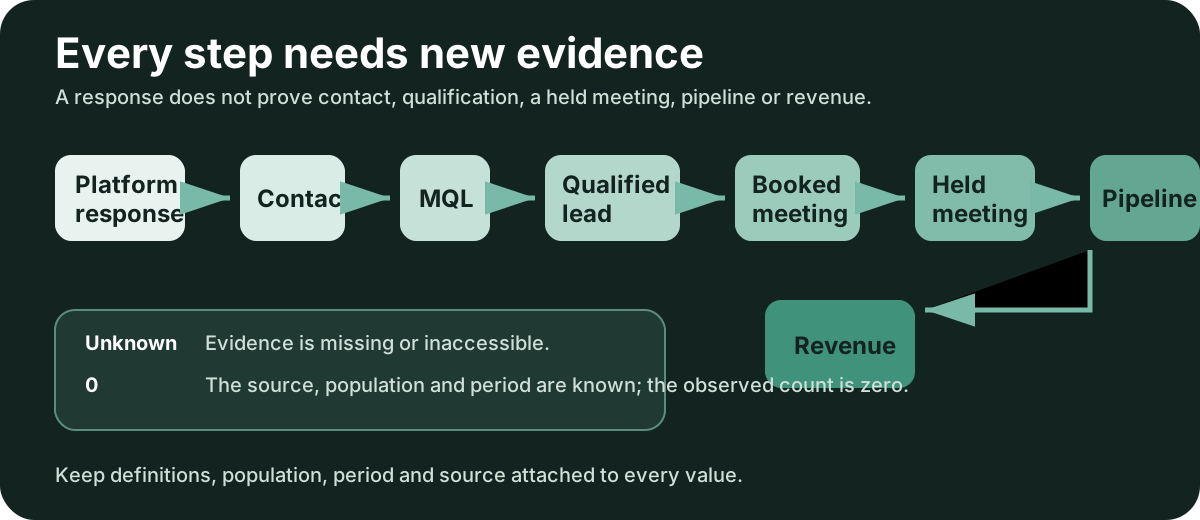
The planner uses this outcome ladder:
- Platform response: a click, view, reaction, native form event or other platform-recorded action.
- Contact: an identifiable person or account record.
- MQL: a marketing-defined status, if the company uses one.
- Qualified lead: a record that satisfies the agreed qualification rule.
- Booked meeting: time is scheduled.
- Held meeting: the meeting happened.
- Pipeline: an accepted opportunity exists in the CRM.
- Revenue: the company’s recognized outcome is recorded under its own definition.
None of these states proves the next one. A click is not a contact. A contact is not qualified. A booked meeting is not a held meeting. Open pipeline is not revenue.
Use Unknown when the evidence is missing or inaccessible. Use 0 only when the source, population and period are known and the observed count is zero. Replacing Unknown with zero makes a broken handoff look like a performance result.
Three video patterns and the job each one does
These public Meta ads are teaching examples. Their advertisers own the creative. The Ad Library records and saved full media let us inspect visible structure, not targeting, spend, conversion or profitability.
HubSpot: explain a problem, then show the workflow
The creator opens with a follow-up problem and moves into CRM views. That structure can bridge creation and capture: name a recognizable operating problem, then show how the workflow changes. It does not prove the ad generated pipeline.
TeamGantt: show the product decision
The short screen recording stays in the scheduling interface and shows allocation and completion-date decisions. This fits a buyer who already understands the problem and wants to see how the product works.
UKG: let the identified customer carry the proof
An identified customer describes an old manual process and an attributed before-and-after result. The lesson is where to place proof and whose voice should carry it. The claim stays UKG’s and the customer’s; it is not a benchmark or Maestro outcome.
Build the next 90 days
Start with one offer. Complete the planner in this order:
- Enter the audience, buyer problem and current evidence of demand.
- Mark approved expertise or proof as known, Unknown, explicit zero or not applicable.
- Enter the capture path, sales capacity, qualified-lead definition and handoff owner.
- Review the provisional route and the reason for it.
- For each motion, name the message, asset, path, owner, handoff event, evidence, measure and review date.
- Resolve every missing input or leave the affected route on Hold.
- Export the decision record and give it to the owners named in the plan.
The filled worksheet shows the combined Meridian situation. The blank worksheet uses the same fields. The portable prompt returns the same contract when it has enough input and a bounded evidence request when it does not.
How to review the plan
Review the plan as a cohort, not as a bag of totals.
- Keep the audience population and period fixed.
- Keep creation and capture measures separate.
- Record platform responses without calling them contacts.
- Deduplicate contacts before qualification.
- Record sales acceptance and rejection reasons.
- Keep booked and held meetings separate.
- Connect pipeline only when the CRM has an accepted opportunity.
- Preserve Unknown fields and assign an owner to resolve them.
The next decision should repair the weakest supported part of the path. That might be the audience, message, proof, destination, routing, qualification rule or follow-up. Add volume only after the path can explain what happened.
Want another set of eyes on the plan?
Maestro’s free Demand Gen Roast reviews the audience, message, creative, destination and measurement path that are visible today. It can help identify the first gap to fix. It does not replace missing CRM evidence or guarantee an outcome.
Download the planner
Read and copy the standalone planning prompt
You are planning one 90-day B2B demand creation and capture mix. Work only from the supplied facts. Do not invent a channel, budget, benchmark, service scope, result, owner, qualification rule, permission or evidence. The 90-day period organizes work and reviews; it does not promise that pipeline or revenue will mature inside 90 days.

Definitions:
- Demand creation builds awareness, understanding or preference before or beyond an explicit hand raise.
- Demand capture records an identifiable response or intent signal and starts a follow-up path.
- Hold is a correct route when missing information would force a guess.
- Unknown means evidence is missing or inaccessible. Zero is valid only when the source, population and period are known and the observed count is zero.

Required inputs:
1. Offer.
2. Audience and population source.
3. Buyer problem.
4. Existing demand evidence and its source.
5. Approved proof or expertise and claim limits.
6. Capture path.
7. Sales capacity.
8. Qualified-lead definition.
9. Creation owner, capture owner and handoff owner.
10. Constraints, permissions and unresolved inputs. Give each unresolved input an owner or explicitly mark the owner Unknown.

Route rules:
- Return Hold when a core input needed for an accountable, measurable path is Unknown. Name the missing input, owner and required evidence.
- Return Creation first when current demand evidence is absent or weak, approved expertise or proof exists, and a follow-up path can be defined.
- Return Capture first when relevant intent or response evidence exists, a matching destination is available, and sales can accept and document the handoff.
- Return Combined when the team has both an education need and a defensible capture path, with distinct owners and measures.

For every recommended motion, return: motion; days; audience; message; asset; path; owner; handoff event; handoff evidence; measure; review date; unresolved inputs. Never make a form fill, click, video view or MQL equal a qualified lead or pipeline. Keep these outcome states separate: platform response, contact, MQL, qualified lead, booked meeting, held meeting, pipeline and revenue.

Output exactly these Markdown headings:
# 90-day operating mix
## Provisional route
## Why this route
## Input record
## Motion plan
## Handoff contract
## Outcome-state record
## Unresolved inputs
## Next review

Under Input record, use a table with input, supplied value, evidence state and source/owner. Under Motion plan, use one table per motion. Under Outcome-state record, list all eight states and preserve Unknown, explicit zero and not applicable. Under Unresolved inputs, give each item an owner and the evidence needed. Under Next review, name the fixed population, evidence to bring, decision to make, date and owner.

If the user supplies forecast numbers, label them forecast rather than outcome. If they supply no observed values, keep outcome states Unknown instead of entering zero. If owners or dates are missing, use Hold for the affected motion and request them. End with one sentence stating that this is a planning record, not a performance forecast.

USER INPUT:
{{PASTE_INPUTS_HERE}}Frequently asked questions
Is demand generation better than lead generation?
No. They do different jobs. Choose creation when buyers need education, trust or a new point of view. Choose capture when relevant intent exists and the response path can serve it. A team can run both with different measures.
Does demand generation include lead generation?
Some teams use demand generation as the umbrella term. For planning, separate creation from capture so each motion has a clear job, owner and measure.
Is gated content demand generation or lead generation?
It depends on the job. A resource can help a buyer diagnose a problem. Requiring a form turns its delivery into a capture event. That event still does not prove the person is qualified or sales ready.
Should every response go to sales?
No. Sales should receive records that meet the agreed handoff rule with enough context to act. Other responses can stay in a permitted follow-up or education path.
What should a B2B team measure first?
Measure whether the intended audience saw or used the asset, whether the response path preserved context, whether sales accepted the handoff, and whether booked meetings were held. Add pipeline and revenue only when the CRM evidence exists.
What if important inputs are missing?
Choose Hold for the affected route. Name the missing input, the owner who can supply it and the evidence needed. Unknown is an operating state, not a number to replace with zero.