
6 B2B Lead Magnet Examples You Can Actually Build
A good B2B lead magnet helps one buyer finish one piece of work. It might help them make a decision, calculate a business case, align a team, interpret research or apply a technical standard.
START WITH THE BUYER TASK
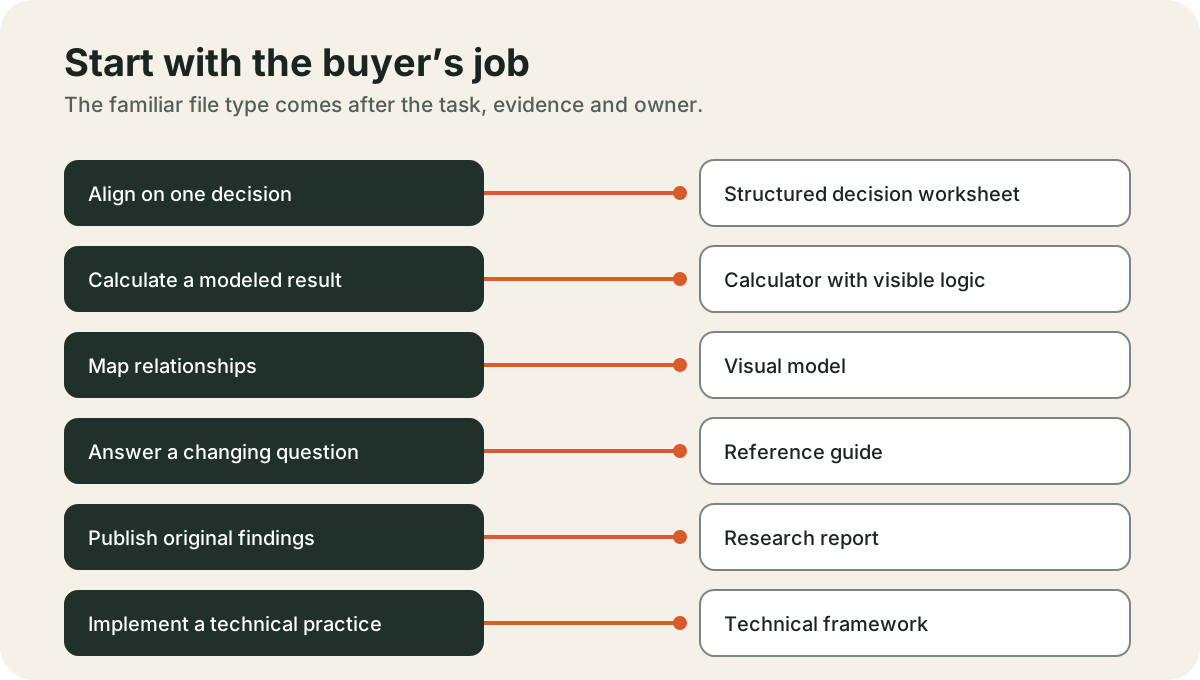
A decision task starts with a structured worksheet
It turns evidence, unknowns and choices into one bounded decision.
Selection logic drawn from the six inspected mechanisms below. This example choice is not a performance claim.
Choose the mechanism from that job. Do not start with “we should make an ebook.” Start with the problem the buyer has, the evidence you can supply and the person who will keep the resource current.
This guide inspects six public B2B resources from the inside where access permits. You can compare the mechanism behind each one, see what its smallest complete version would contain, and use the workspace to choose a mechanism. Then carry that decision into the downloadable production brief, where you add the sources, claim limits, build rules and review ownership.
The examples show structure and execution. They do not prove conversion rate, pipeline or revenue.
Choose the lead magnet in three tests
1. What exact task should the buyer finish?
Write the task as a visible completion state.
- “Understand account-based marketing” is a topic.
- “Choose which 20 accounts deserve a one-to-one plan” is a task.
- “Learn about attribution” is a topic.
- “Decide which three events belong in our first reporting model” is a task.
The tighter statement tells you what the asset must produce. A worksheet can end with a decision. A calculator can end with a modeled range. A reference guide can end with a diagnostic check. If you cannot name the output, the resource will usually become a collection of information with no finish line.
2. What evidence or inputs do you have?
The format cannot create facts that your team does not have.
A calculator needs defined inputs, equations or a documented model. A research report needs a real sample, method and limitations. A customer benchmark needs permission and source data. A template needs enough practical knowledge to show a completed example.
If those inputs are missing, hold the format and choose the next action that produces them. A polished calculator with invented benchmarks is worse than a plain worksheet that keeps the unknowns visible.
3. Who will keep it current?
Every resource has an update burden.
A two-page worksheet can stay sound for a long time. A calculator tied to prices and benchmarks can age quickly. A technical framework may need continuous revision. Name the owner, review trigger and source of truth before you choose a high-maintenance mechanism.
The smallest complete asset is the version that finishes the buyer task without pretending to know more than you know. It is not simply the shortest file.
DECISION WORKSPACE
Choose the mechanism from the buyer job
Fill the six fields. Unknown inputs stay unknown, and missing evidence or ownership keeps Draft on Hold.
Draft: hold
SELECTED MECHANISM
No mechanism selected
Next:
The workspace produces a decision record, not the full production brief. Export the record, open the blank production brief, and transfer the buyer job, completion state, selected mechanism, evidence categories and owners. Then add each exact source and permission, allowed or excluded claim, section or calculation logic, delivery requirement, reviewer and update trigger. Keep any missing item as Unknown with an owner question before you hand the brief to production.
Six mechanisms at a glance
| Buyer needs to… | Start with… | Required inputs | Complete output | Main risk |
|---|---|---|---|---|
| Align people on a problem and scope | Structured worksheet | Decision questions, owners and known unknowns | One shared project definition | A blank form with no worked depth |
| See how several parts relate | Visual model | Named components, relationships and examples | One coherent map | Attractive boxes with no decision logic |
| Test the effect of changing inputs | Calculator | Defensible inputs, formulas or model notes | A result with visible assumptions | False precision or hidden benchmarks |
| Diagnose or apply a recurring concept | Reference guide | Definitions, conditions and next checks | A repeatable decision path | A long glossary with no action |
| Interpret new evidence | Research report | Method, sample, definitions and findings | Decision-relevant interpretation | Charts without a clear method or limit |
| Apply a complex standard | Technical framework | Questions, practices, risks and resources | A consistent assessment and action path | An unmaintainable encyclopedia |
Use the table to make a provisional choice. Then inspect the examples below and reject any mechanism that cannot complete your buyer's task with the material you actually have.
1. Atlassian Project Poster: a worksheet that makes unknowns visible
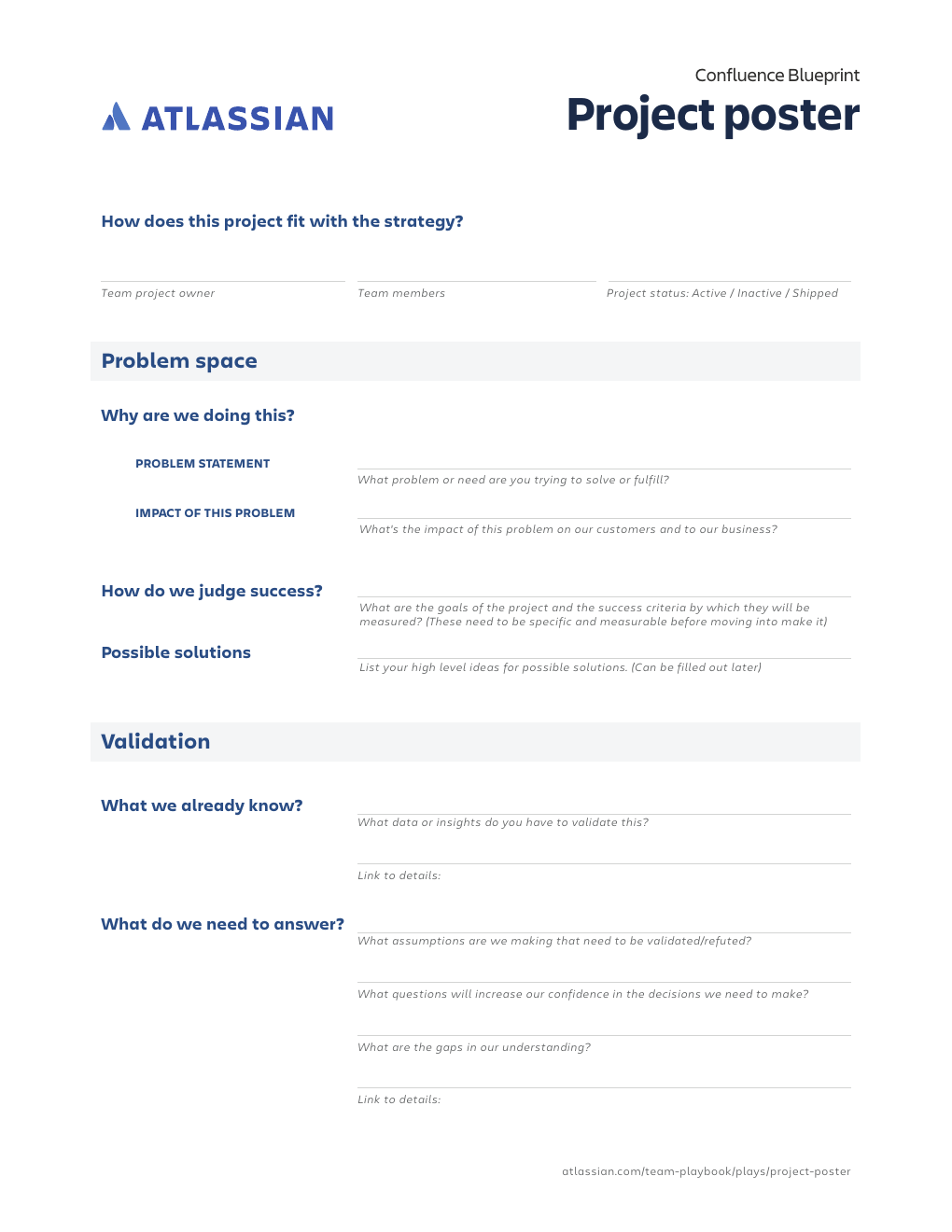
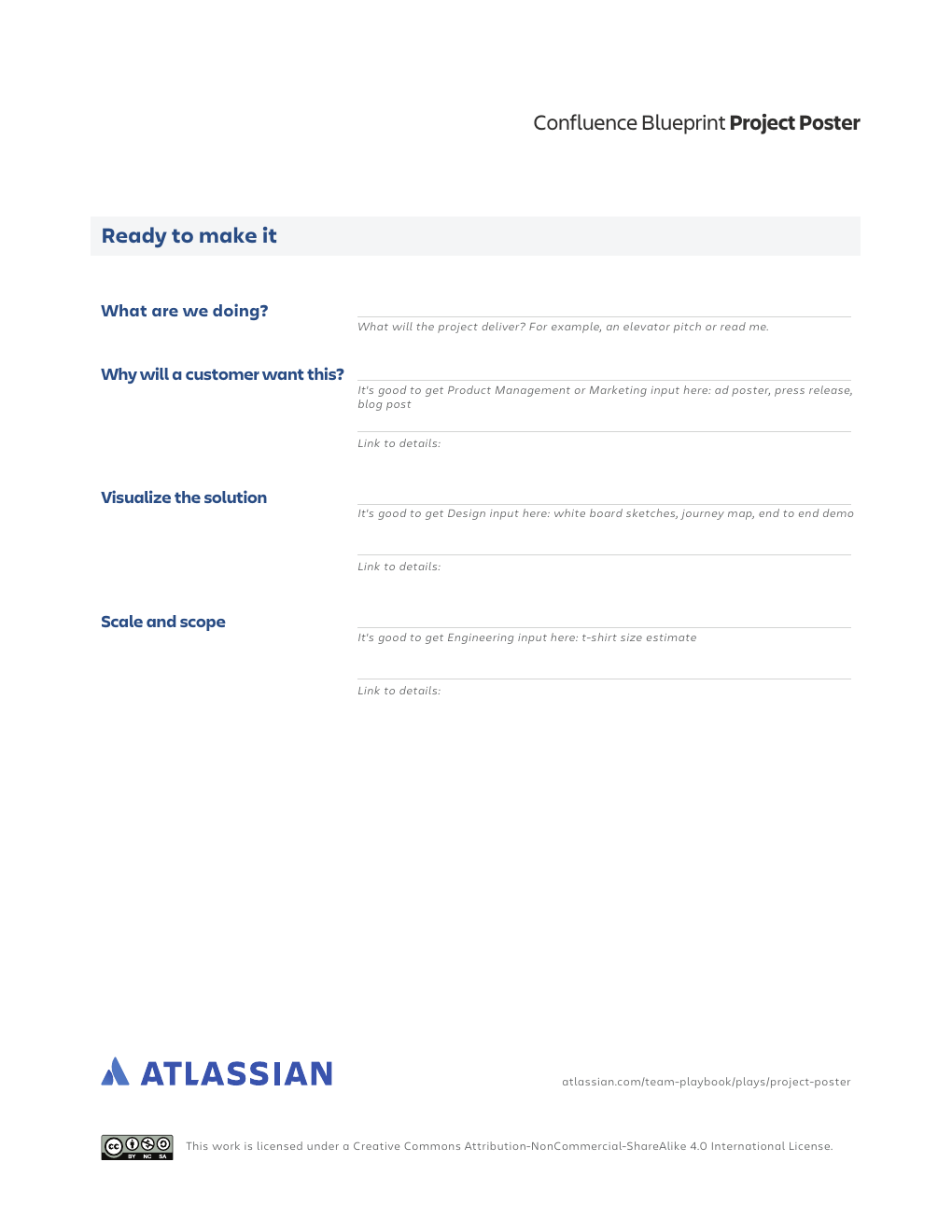
Atlassian's Project Poster is a two-page decision worksheet. The public PDF asks a team to connect strategy, problem, impact, measurable success, evidence gaps, possible solutions, the intended deliverable, customer value and project scope.
The strength is the order. It does not begin with a list of tasks. It asks the team to define why the project exists, what is known, what is still assumed and what the work should produce. That makes it a strong model when the buyer needs alignment before execution.
What to copy
- Move from problem to evidence to unknowns to deliverable.
- Give every completed worksheet an owner.
- Pair the blank worksheet with a filled example so the expected depth is visible.
What to reject
Do not ship a page of empty boxes and call it a toolkit. A template becomes easier to use when the buyer can see what a defensible answer looks like.
Smallest complete version
One page can be enough if it captures the buyer problem, decision, known evidence, open questions, owner and next action. The blank form alone is incomplete; add a worked example.
The inspected file is a blank template. It shows the structure, not evidence that a team completed a project or achieved a result.
2. Miro Business Model Canvas: a visual model that exposes relationships
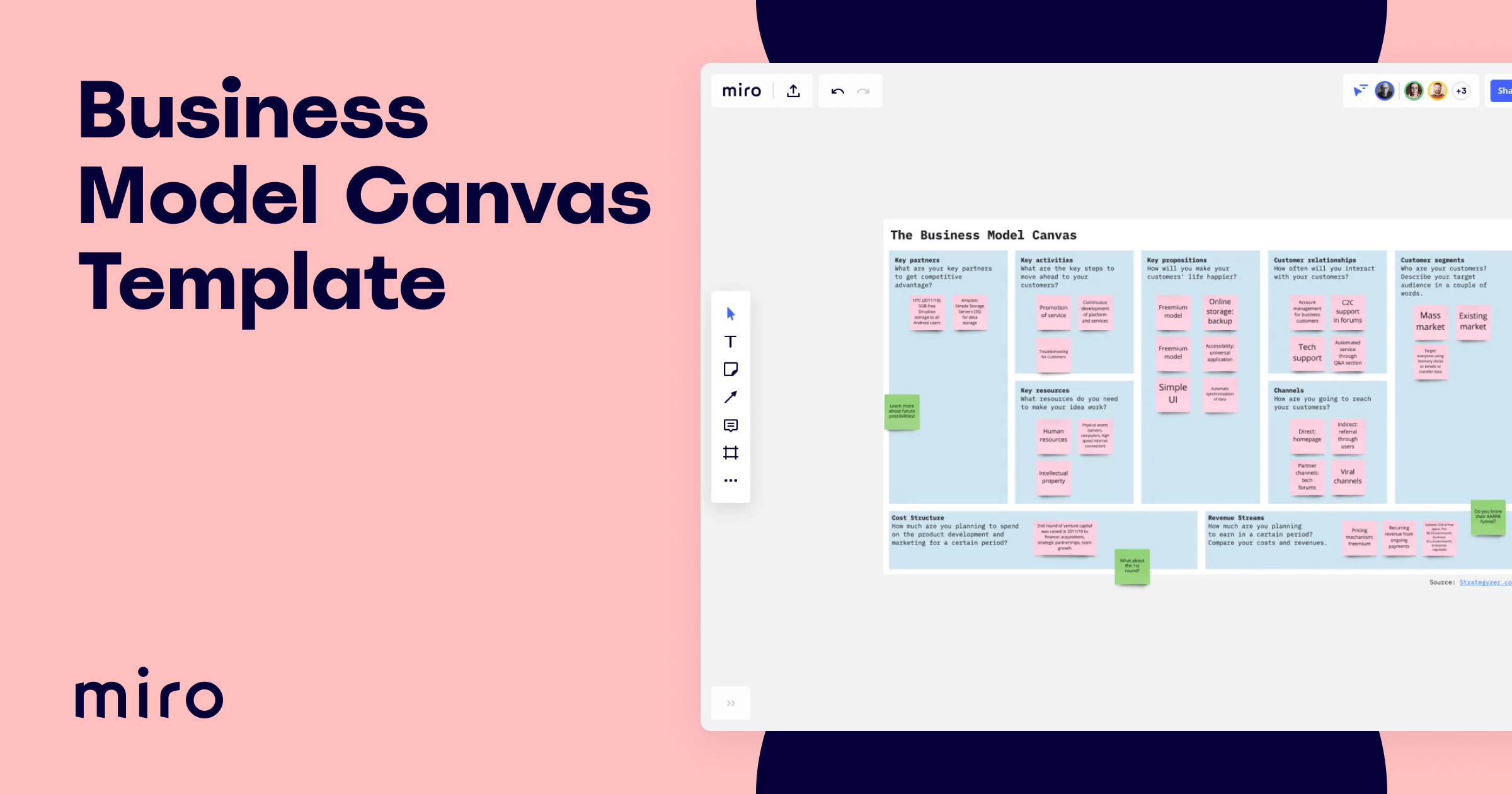
Miro's Business Model Canvas template shows the familiar canvas as one surface with named sections, guiding questions and example sticky notes. Its value comes from seeing several parts together: customer segments, value propositions, channels, activities, resources, partners, revenue and costs.
Use this mechanism when the relationship between answers matters. A linear guide can explain every component, but a canvas lets the reader see that changing one assumption should change several others.
What to copy
- Use named cells for parts the buyer must consider together.
- Put prompts inside the working surface.
- Show a worked example with the same structure as the blank version.
What to reject
Do not choose a canvas because it looks more designed than a worksheet. If the task is sequential or depends on calculation, a canvas can hide the order the buyer needs.
Smallest complete version
Use only the cells required for the decision. For an account plan, that might be business priority, stakeholder, current signal, evidence gap, message angle and next action. A nine-box model is not automatically better than a six-box model.
Our inspection covered the populated public preview. We did not verify the editable board, collaboration behavior or exports, so this example supports the visual mechanism rather than claims about the software experience.
3. HubSpot Marketing ROI Calculator: a public result with visible assumptions
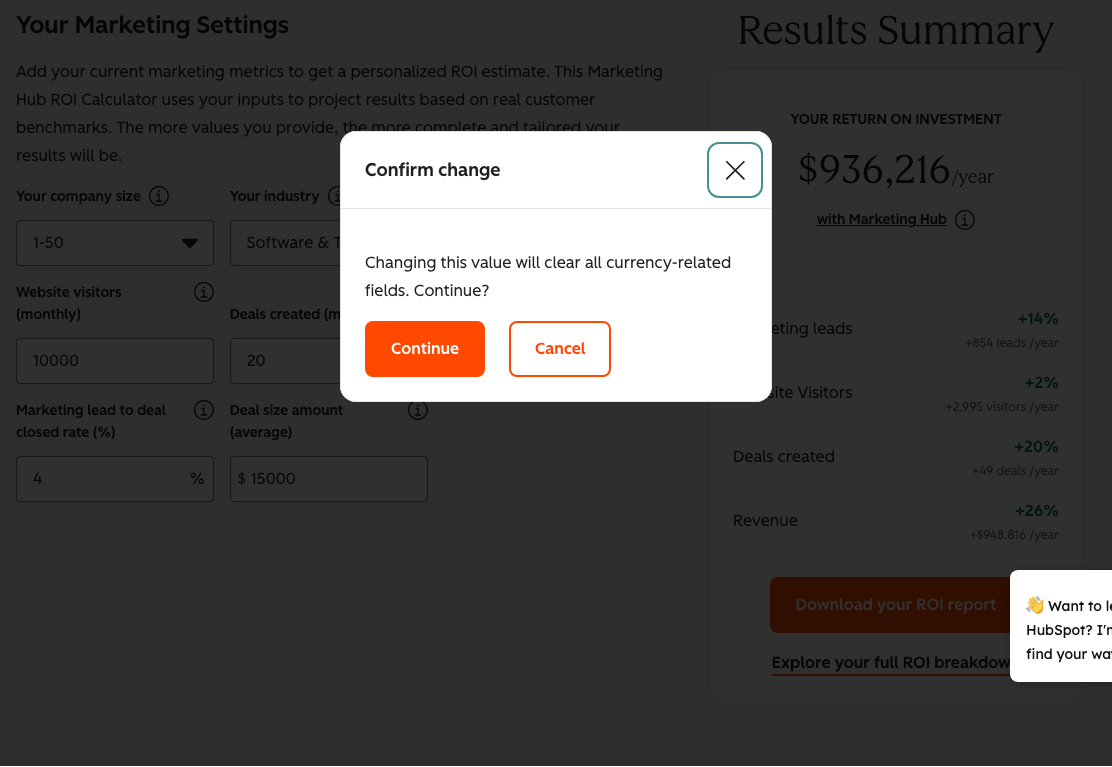
HubSpot's Marketing ROI Calculator asks for company size, industry, currency, website visitors, monthly deals, monthly marketing leads, lead-to-deal rate and average deal size. It returns modeled before-and-after values for leads, visitors, deals, revenue, investment and ROI. The reader can change the time period and some assumptions before requesting a report.
We ran the public calculator with fictional inputs: a software company with 1–50 employees, 10,000 monthly visitors, 500 monthly marketing leads, 20 monthly deals, a 4% lead-to-deal rate and a $15,000 average deal size. The vendor model returned $936,216 in annual modeled ROI, $948,816 in modeled annual revenue increase, 854 additional leads, 2,995 additional visitors and 49 additional deals.
Those figures are HubSpot's model output for the fictional fixture. They are not a forecast, benchmark for your company or independently audited equation. HubSpot also states that results are not guaranteed and provides method and cohort notes in the calculator FAQ.
What to copy
- Keep the calculation usable before the form.
- Show entered assumptions beside the result.
- Let the reader revise inputs and see the result change.
- Use the contact form for a saved report or follow-up asset, rather than hiding the first answer.
What to reject
Do not create a calculator from a marketing claim. If the team cannot document the inputs, logic, source and update owner, call it a planning worksheet or hold it until the model exists.
Smallest complete version
One decision, three to six required inputs, visible arithmetic or model notes, one result and a plain statement of what the result can and cannot support.
10,000 monthly visitors, 500 monthly leads, 20 monthly deals, 4% lead-to-deal rate and a $15,000 average deal size produced HubSpot model output of $936,216 annual ROI, $948,816 annual revenue increase, 854 additional leads, 2,995 additional visitors and 49 additional deals.
The model was not independently audited. The visible revenue uplift is a separate benchmark card, not simply additional deals multiplied by entered deal size.
4. Intercom's customer-service metrics guide: a reference that changes the next check
Intercom's guide to customer-service metrics is an ungated article. That is fine. A resource earns attention by helping with the task, not by living behind a form.
The pattern is definition, changed context, diagnostic split and next check. When AI systems and people share service work, one combined number can hide what each part of the system is doing. The guide explains the metric, how the operating context changes its meaning and what to examine next.
What to copy
- Define the measure or concept in ordinary language.
- Explain the condition that changes how it should be read.
- Split the problem into the parts that need separate diagnosis.
- End with the next check or decision.
What to reject
Do not build a 40-term glossary when the buyer only needs to diagnose five measures. More definitions create more maintenance and can bury the decision.
Smallest complete version
Choose the few concepts that control the buyer's next decision. For each one, give a definition, the condition that changes it, a diagnostic question and the next action.
This is public editorial guidance. We did not treat it as evidence that an ungated guide generates leads or pipeline.
5. Salesforce State of Service: research with a visible method
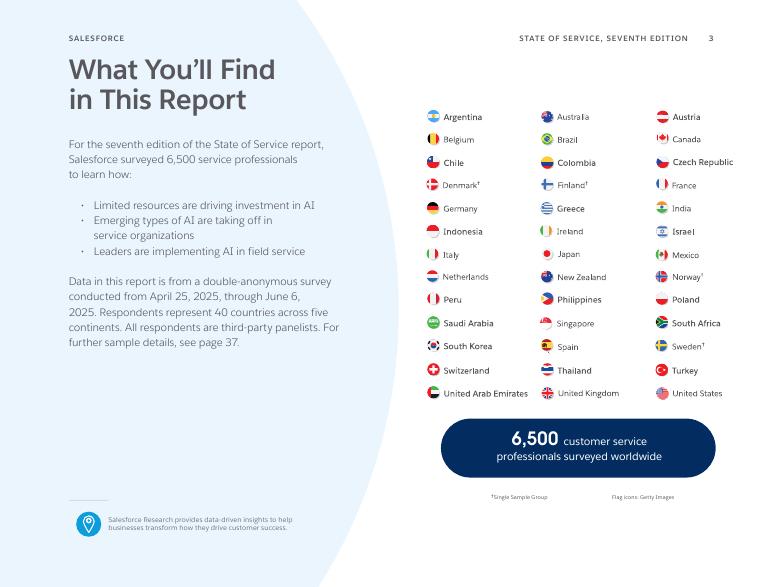
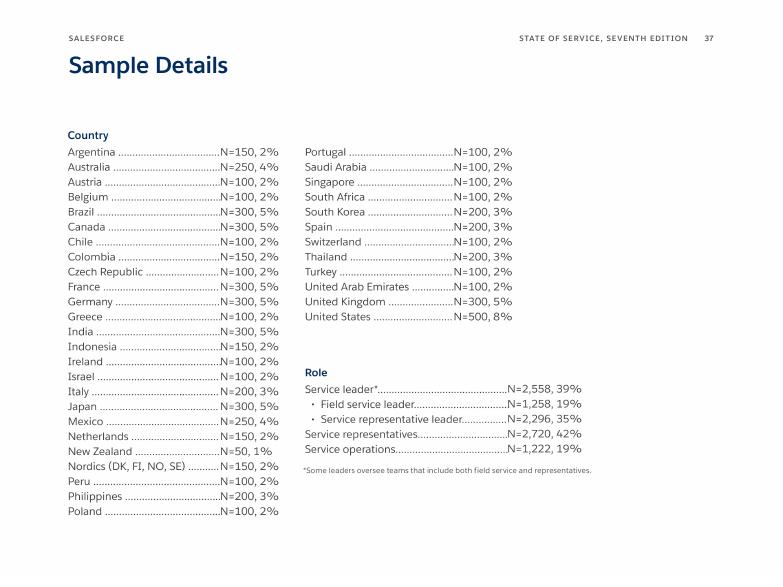
Salesforce's State of Service, Seventh Edition is a 39-page research report. The inspected report includes the research questions, respondent definitions, executive summary, chapter findings, labeled charts, a maturity model and a sample appendix.
The report format fits a buyer who needs to understand a changing market or operating question, brief colleagues and decide what to investigate next. Its value is not the PDF length. It is the chain from method to finding to interpretation.
What to copy
- State the research question before presenting findings.
- Define the population, dates and important terms.
- Label charts so the reader knows what was measured.
- Separate the observed result from the recommendation.
- Keep the method and limitations easy to find.
What to reject
Do not turn five internal observations into an “industry report.” A small qualitative study can still be good, but the title, method and claims must match the evidence.
Smallest complete version
A short research note can work if it contains the question, population or source set, method, definitions, limitations, decision-relevant findings and the next action. Cut pages before you cut those parts.
The report supports the structural observations above and the attributed survey findings inside it. It does not show what commercial result the report produced for Salesforce.
6. AWS Well-Architected Framework: a technical path from question to action
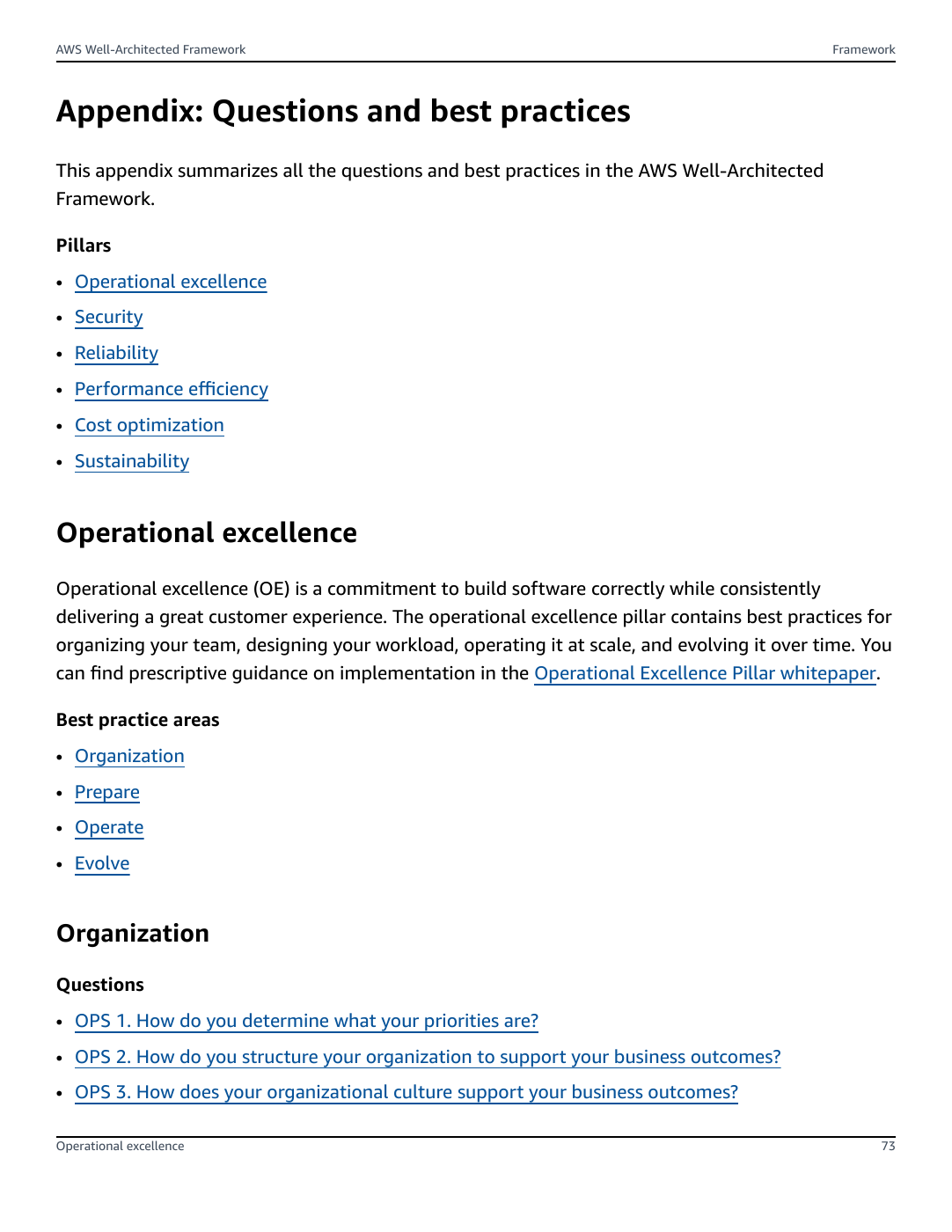
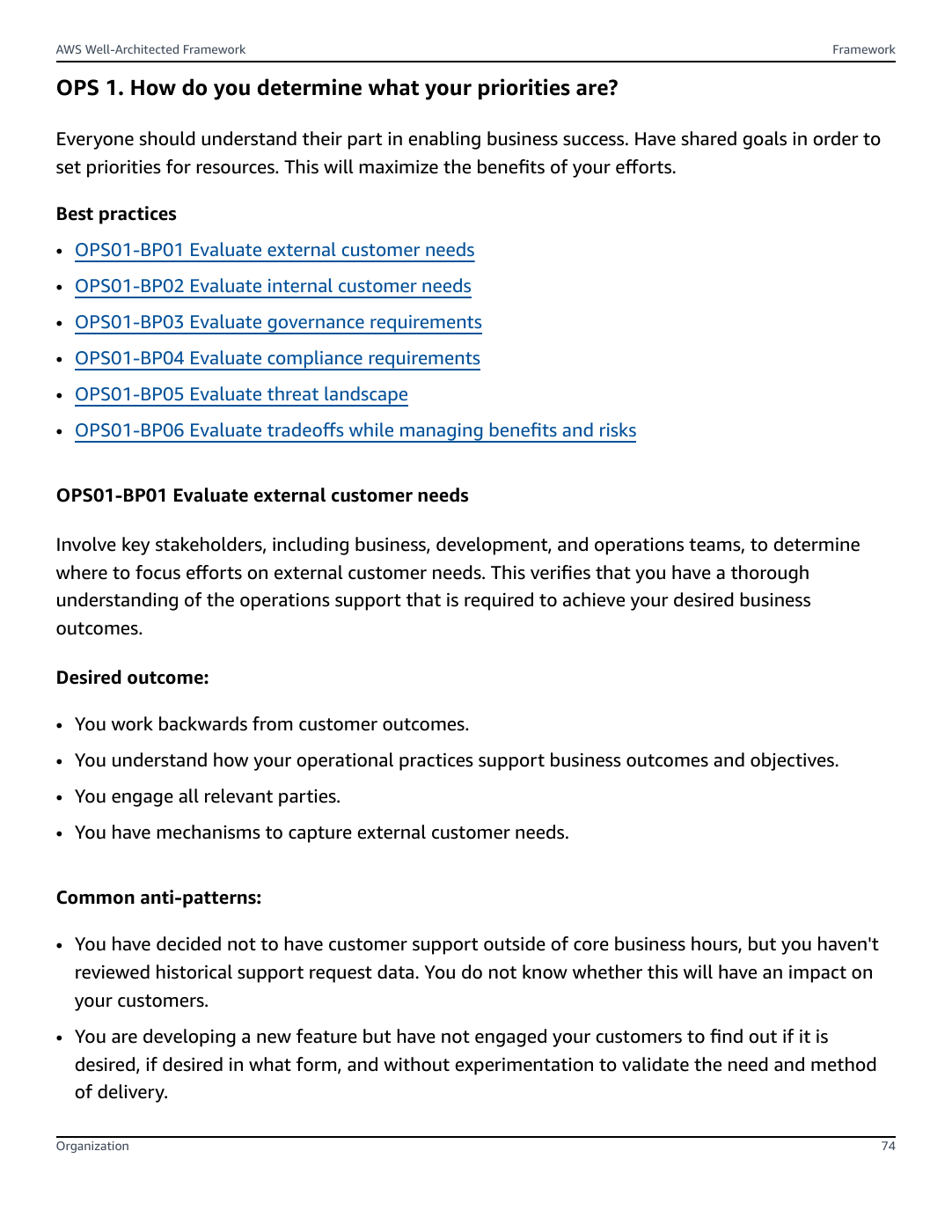
The AWS Well-Architected Framework organizes a large technical domain into pillars, questions, desired outcomes, common anti-patterns, benefits, risks, implementation guidance and further resources.
The current public PDF is 1,002 pages. We extracted the complete text and manually inspected the opening, contents, appendix and selected implementation sections. Treat this as sampled inspection of a very large public framework, not a line-by-line endorsement of every page.
The pattern to borrow is much smaller than the document. A reader starts with one diagnostic question, recognizes an anti-pattern, sees the desired state and follows implementation guidance. The framework gives repeated decisions a stable structure.
What to copy
- Organize the asset around questions the buyer must answer.
- Name the desired outcome and common failure.
- Connect the diagnosis to a specific practice or resource.
- Assign an owner and review date to material that changes often.
What to reject
Do not copy the length. A broad framework without maintenance ownership becomes stale and hard to apply.
Smallest complete version
Start with one decision area. Include the question, desired outcome, warning signs, recommended practice, evidence required and next action. Add another module only when it completes another recurring buyer task.
AWS describes its own technical guidance. This example does not establish adoption, commercial results or lead-generation performance.
A lead magnet is complete when the buyer can finish the promised step
Alex Hormozi describes a lead magnet as a complete solution to one painful step rather than a partial solution to a much larger problem. His 40-second explanation uses a house-sale example to make that point.
Treat that as a design test, not evidence of B2B conversion. Ask: can the buyer finish the promised step using only this asset and the inputs it names?
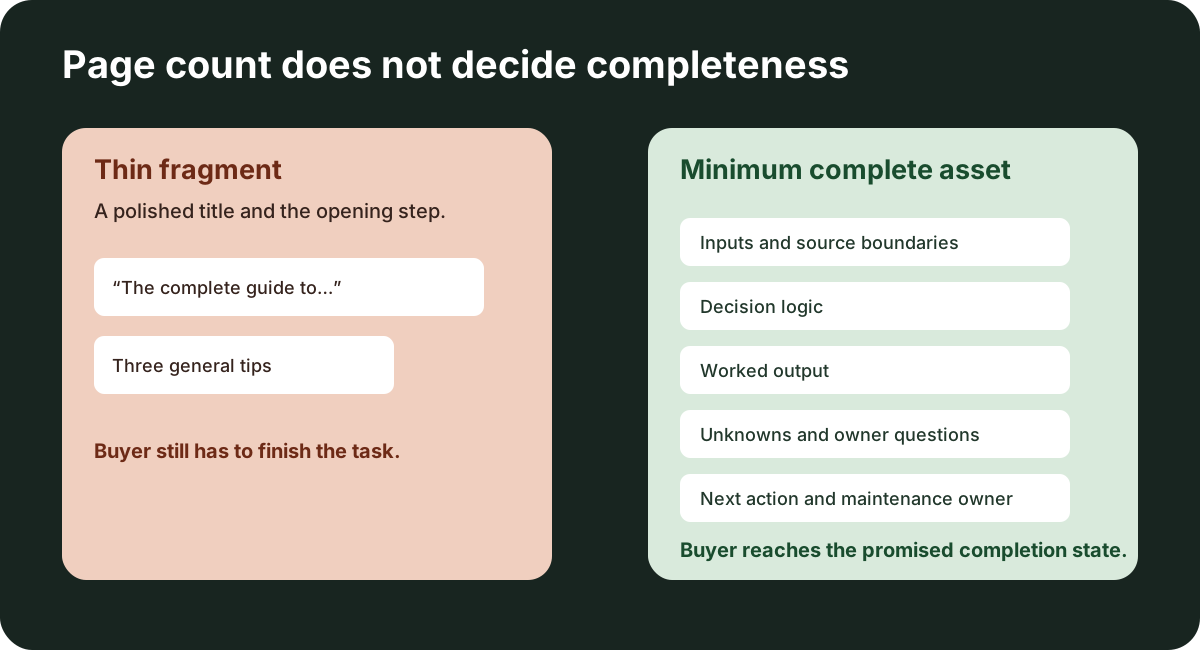
A thin asset usually stops at one of these points:
- It explains a topic but produces no decision or output.
- It provides a blank template without a worked example.
- It shows a calculation without inputs, method or limits.
- It lists recommendations without saying which condition makes each one apply.
- It ends with “book a call” before delivering the promised answer.
A complete first version can still be short. It names the task, uses the evidence available, produces a defined output, preserves unknowns and tells the buyer what to do next.
Build the first version in seven steps
1. Write the buyer job
Use this sentence:
When [situation], help [buyer] decide or complete [task] so they leave with [visible output].
If the sentence contains two buyers or five outputs, split the asset.
2. List the inputs you can defend
Record the source, date, owner and permission for each fact, equation, quote, example or benchmark. Mark missing evidence as unknown. Do not ask design or an agent to fill the gap with plausible copy.
3. Choose the mechanism
Choose the mechanism that performs the work:
- use a worksheet for alignment or a documented decision;
- use a visual model when relationships matter;
- use a calculator when defensible inputs change a result;
- use a reference guide for a recurring diagnosis;
- use a research report for new evidence and interpretation;
- use a framework for repeated complex assessments.
4. Define the minimum complete output
Write what the buyer will have at the end. Then remove every section that does not help produce or understand that output. Keep the method, proof boundary and next action.
5. Build a completed example
Use fictional details when you need a safe demonstration, and label them. The worked example should use the same fields and logic as the blank version. If the example needs secret context from the article, the asset is not portable yet.
6. Create the production and maintenance handoff
Name the source files, allowed claims, required sections, design constraints, export formats, owner, reviewer, review trigger and next review date. High-maintenance assets need stronger ownership before launch.
7. Test the promised task
Give the resource to someone without this article. Ask them to complete the task, export the result and explain the decision. Record where they stop, what they misunderstand and which claim they cannot verify. Repair those failures before you add promotion.
Use the complete planning kit
The tools below are designed to leave the article and still work.
Lead magnet contract
Define the buyer, situation, job, completion state, available evidence, unknowns, selected mechanism, owner and review trigger.
Blank and worked selection matrix
Compare mechanisms by task fit, required evidence, complete output, proof boundary, maintenance burden and distribution route. The worked matrix shows how one fictional event-selection task rejects five mechanisms and selects a structured worksheet.
Complete fictional minimum asset
Inspect a finished fictional B2B resource in Markdown and JSON. It is a real completed example rather than a content outline. The two files preserve the same fields and can be checked against each other after export and import.
Blank and completed production brief
Hand the source ledger, section contract, logic, design requirements, claims, owner, review and maintenance plan to the person building the asset.
Use the workspace export as the starting record. The production brief is the handoff: copy the selected mechanism and owners, then complete the source ledger, claim ledger, section or calculation contract, delivery test and review schedule. If a required source, permission, logic rule or reviewer is missing, keep it Unknown and assign the question instead of inventing the answer.
Standalone build and review prompts
The build prompt creates the asset only from supplied facts and preserves unknowns. The review prompt checks task completion, evidence, internal consistency, portability and maintenance without inventing results.
What happens after the asset is chosen?
This page owns the asset decision and the first complete version. Use the next guide for the job that follows:
- Put the offer and form on a page: B2B landing page examples
- Build a native Meta form: Facebook Lead Ads
- Turn the resource into a LinkedIn sponsored document: LinkedIn Document Ads
- Plan distribution in Campaign Manager: LinkedIn ad campaign guide
Gating and distribution should follow the buyer task and delivery experience. They cannot rescue an incomplete asset.
Measure the task before the lead
First check whether the resource completes the job it promises. For a worksheet, that might be the share of started copies that end with a decision and named owner. For a calculator, it might be the share of sessions that reach a result with all required inputs and visible assumptions. For a reference guide, it might be whether the reader reaches a named diagnosis and next check.
Keep that completion measure separate from form fills, meetings, pipeline and revenue. A form fill proves capture. It does not prove the resource solved the task. Pipeline and revenue are later commercial outcomes with more causes than the asset alone. Record each stage separately so a high capture rate cannot hide an unfinished resource, and a useful resource is not credited with revenue it did not establish.
Build the resource around the buyer's next decision
Start with the smallest buyer task you can finish well. Choose the mechanism from that task, the evidence you have and the maintenance you can own. Then test the complete resource before you spend time promoting it.
If you want help turning the buyer problem, source material and distribution plan into a campaign, talk to Maestro.