B2B Meta Ads Agency
Decide whether Meta fits your B2B market, see the system Maestro would build, inspect seven public ads, and leave with a 90-day plan.
Meta can work for B2B. It just does not work like a cheaper version of LinkedIn.
The mistake is treating Facebook and Instagram as places to buy cheap form fills. That gives sales the thing they hate most: lots of names, very few real conversations, and no clear way to tell the platform what a good lead looks like.
Maestro runs B2B paid media around a different idea. Start with the companies and people your sales team already wants to reach. Match those contacts into LinkedIn and Meta where possible. Run founder-led and problem-led ads. Send people to a useful landing path. Then track engagement and qualified meetings in your CRM so the system improves around quality instead of raw lead volume.
That is the job of this page. It will help you decide whether Meta belongs in your B2B paid media plan, what has to be true before it works, and what Maestro would look at before recommending spend.
Quick answer
A B2B Meta ads agency should do more than manage campaigns.
It should help you answer five questions:
- Who exactly are we trying to reach?
- What problem will stop them in a personal feed?
- What next step is believable for this buyer?
- How will sales know whether the lead is worth following up?
- How will that feedback get back into the campaign?
If an agency cannot answer those questions, it is probably selling media buying. That is not enough for B2B.
Choose your path
Use this page based on what you are trying to decide.
| If you are thinking… | Start here |
|---|---|
| “Can Meta even work for our market?” | Check the strong-fit and weak-fit signals. |
| “We tried Facebook and the leads were bad.” | See the four common causes of bad leads. |
| “We already run LinkedIn. Why add Meta?” | Compare Meta and LinkedIn. |
| “What would Maestro actually do?” | Read the first-90-days plan. |
| “I need examples before I believe this.” | Inspect seven public ad examples. |
| “I want to prepare for a call.” | Use the readiness tools. |
Are you a strong fit for B2B Meta ads?
Meta is a strong channel when the market is clear, the offer is specific, and the campaign has enough signal to learn from.
It is a weak channel when the business is still guessing who it sells to, the offer is generic, or every form fill is treated as sales-ready.
| Strong fit | Weak fit |
|---|---|
| You sell to a defined market with recognizable job problems. | You still cannot describe the buyer, trigger or use case clearly. |
| You have target accounts, customer lists, CRM records or useful website traffic. | You want Meta to find your ICP from broad interests alone. |
| Sales can follow up quickly and tell marketing which leads were real. | Sales ignores campaign leads or gives no feedback. |
| You have founder, customer, product or expert material that can become useful creative. | You only have polished brand ads with no clear problem. |
| You can give the campaign time to learn. | You want a one-month test that proves pipeline immediately. |
| You care about qualified meetings, opportunities and sales conversations. | You only want the lowest CPL. |
The simplest version is this: Meta needs a system around it. Audience, creative, offer, page, form, CRM and follow-up all have to work together.
What Maestro does
Maestro runs contact-level B2B paid media for PE-owned and VC-backed B2B companies.
The current Maestro system has three parts:
- Reach the exact people sales wants. We use the account and contact lists that matter. We add the data needed to match those people where possible. Then we build audiences in LinkedIn and Meta.
- Build trust with founder-led ads. We turn the founder’s ideas and the company’s point of view into video, image and post-based ads. Each ad should make one problem clear.
- Help sales follow up. We build landing pages and send engagement and qualified meeting signals into the CRM. Sales can see who is paying attention.
That matters because B2B buyers rarely go from a cold Facebook impression to a closed deal. The useful outcome is usually a better-known account, a warmer contact, a clearer hand-raise, a stronger retargeting pool, or a qualified meeting sales can actually use.
Agree on creative and lead-quality ownership
Before signing, name who supplies the founder recordings, approved product claims, and customer proof; who turns them into ads; and who approves each version. Put concepts, video cutdowns, aspect ratios, revisions, and landing-page work into the scope. A campaign-management fee alone does not tell you how much creative will be produced.
Then agree with sales on what makes a response qualified. Record the account fit, buying role, relevant problem, and next step separately from the form submission. Give one person responsibility for recording that decision in the CRM and returning the reason for rejected leads to the campaign team.
Use the Facebook ads reporting template to compare delivery with downstream quality. Use the Meta budget calculator to test your cost assumptions before committing spend. Its estimates are planning scenarios, not a Maestro quote or a result forecast.
The B2B Meta system
A good Meta program is not just an ad account. It is a loop.
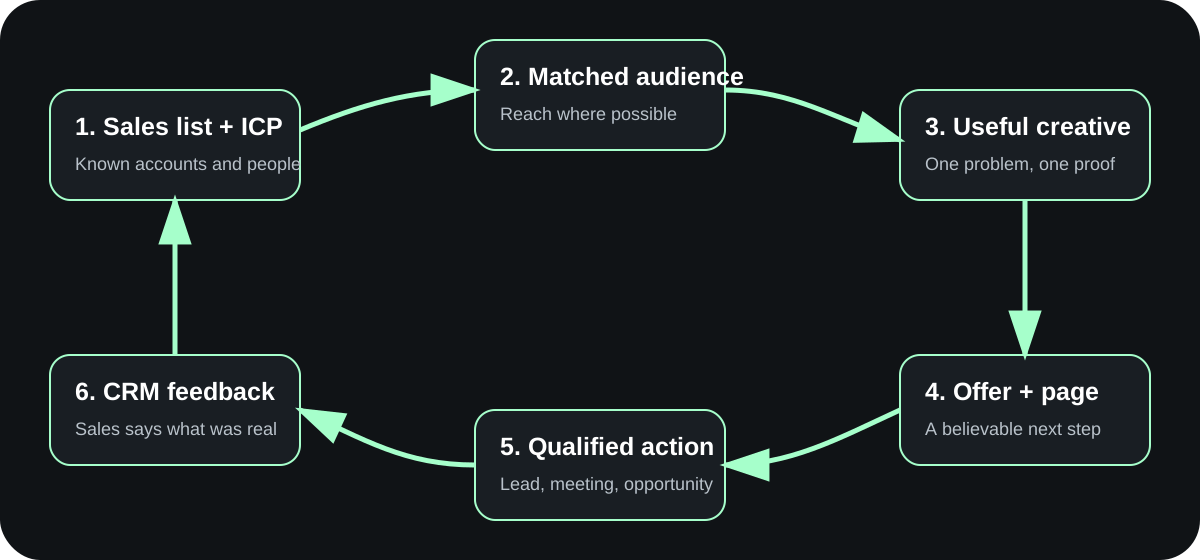
Each part changes the result.
If the list is weak, the audience is weak.
If the creative sounds like a corporate brochure, buyers scroll past it.
If the offer is too big for a cold feed, people do not convert.
If the form lets anyone through, sales wastes time.
If the CRM feedback never returns to marketing, the campaign keeps optimizing toward the wrong people.
This is why B2B Meta often fails. The ad platform gets blamed, but the real problem is usually the system around the platform.
Meta vs LinkedIn for B2B
When both channels support the same account plan, decide what each can reach before dividing the budget. Our account-based advertising guide explains LinkedIn company audiences, Meta contact and engagement audiences, expansion settings, and how to count CRM outcomes across channels.
LinkedIn and Meta solve different jobs.
LinkedIn gives you direct professional targeting. That is powerful. It is also expensive, and the feed is full of other B2B ads.
Meta gives you lower-cost reach, strong video and image formats, and a different place to build familiarity. The tradeoff is that you need better creative and stronger feedback because native professional targeting is not as direct.
| Channel | Best at | Risk |
|---|---|---|
| Job-title, company, seniority and account-based targeting. | High costs, crowded B2B feed, expensive creative testing. | |
| Meta | Cheaper reach, retargeting, video, founder stories, lead magnets and repeated proof. | Broad targeting, bad leads if forms and feedback are weak. |
| Both together | Surrounding the same market with different creative and using CRM feedback to improve quality. | Wasted spend if the channels are run as separate silos. |
Maestro’s default angle is not “Meta instead of LinkedIn.” It is “use LinkedIn and Meta around the same go-to-market logic.”
Public B2B Meta ad examples worth studying
These examples are public ad-library records. They are not Maestro client work and they do not prove performance. They show useful decisions a B2B team can borrow.
1. HubSpot: make the CRM problem human
Source: Public Meta ad record 1445841037399662, retrieved in the prior Facebook-for-B2B research packet. Format: Vertical creator-led video. Observed promise: Follow up at the right time, on the right deal. Next step: Learn more about HubSpot Smart CRM. Source limit: Creative evidence only. The public record does not prove pipeline or revenue impact.
HubSpot’s ad works because it starts with a problem a business owner recognizes. A creator speaks to camera about follow-up chaos. The video then shows contact records and deal cards.
That order matters. The product appears after the viewer understands the pain.
What a B2B Meta agency should borrow:
- Start with one workflow pain, not the full product suite.
- Let a real person explain the problem in normal language.
- Show the product only after the problem is clear.
- Keep the claim grounded. The ad promises organized follow-up, not magical revenue.
What Maestro would test from this pattern:
- founder-to-camera version,
- customer-service or sales-ops version,
- short retargeting cut for people who visited a CRM or pipeline page,
- landing page that continues the same follow-up problem instead of sending people to a generic homepage.
2. monday.com: make the role obvious in five seconds
Source: Public Meta ad record 2484682258601889. Format: Short vertical motion ad. Observed promise: Do not lose strong candidates to slow hiring. Next step: Sign up for monday.com’s HR AI agents page. Source limit: Visual creative evidence only. No reliable spoken claim was detected.
The useful part of this ad is its focus. It does not say “AI work platform for everyone.” It says HR teams lose candidates when hiring moves slowly.
That is a much easier ad to understand.
What a B2B Meta agency should borrow:
- Name the role.
- Name the consequence.
- Show one clear visual scene.
- Send the click to the matching department page.
What Maestro would test from this pattern:
- a sales version for missed follow-up,
- an operations version for handoff delays,
- a finance version for approval bottlenecks,
- separate landing sections for each role instead of one generic AI page.
3. Notion: use an expert story instead of a feature dump
Source: Public Meta ad record 1069499388814060. Format: Square video with named practitioner context. Observed promise: Use Notion as an AI-enabled workspace for knowledge sharing and busywork reduction. Next step: Sign up. Source limit: The video and ad body were inspected separately. The speaker’s story should not be treated as proof for every feature listed in the ad body.
Notion’s ad gives the viewer a person and a work context before it talks about the tool. The speaker is tied to clinical governance and knowledge sharing. That makes the AI workspace feel less abstract.
What a B2B Meta agency should borrow:
- Put the expert or operator in a specific work setting.
- Use product screens to support the story, not replace it.
- Avoid pretending the speaker personally proved every feature claim.
- Retarget viewers with a narrower asset, such as a template or use-case page.
What Maestro would test from this pattern:
- founder explains one workflow belief,
- customer or expert explains one use case,
- product screen shows the before/after state,
- landing page gives a practical template tied to that same use case.
4. monday.com vs Airtable: capture comparison demand honestly
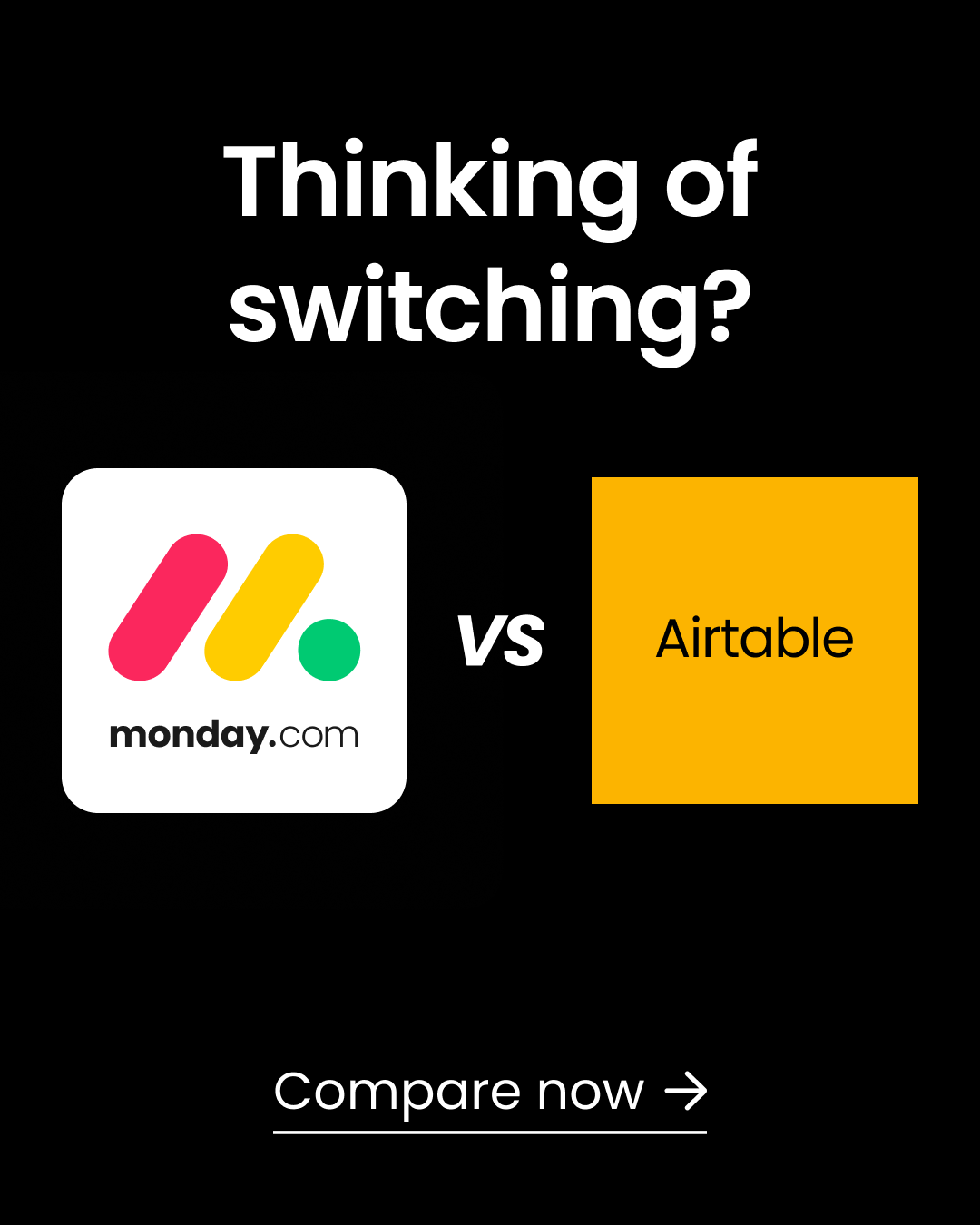
Source: Public Meta ad record 1066220179486628. Format: Static comparison image. Observed promise: Compare monday.com and Airtable on automations, ease of use, scale and AI. Next step: Sign up / comparison page. Source limit: The ad names a competitor and points to a comparison page. The creative itself does not prove monday.com is better.
This is a choice-stage ad. It is for people already considering alternatives.
The value is not the logo fight. The value is that the ad gives a next step that matches the buyer’s question: “How does this compare to the thing I already know?”
What a B2B Meta agency should borrow:
- Use comparison ads only when the page can support the comparison.
- Compare the criteria buyers actually use.
- Do not make a superiority claim the page cannot prove.
- Use retargeting for comparison demand rather than blasting it cold to everyone.
What Maestro would test from this pattern:
- “Meta vs LinkedIn for B2B” retargeting asset,
- “agency vs in-house” comparison page,
- “lead volume vs qualified meetings” diagnostic,
- sales-team follow-up sequence for people who visit comparison pages.
5. Salesforce: make the lead magnet specific
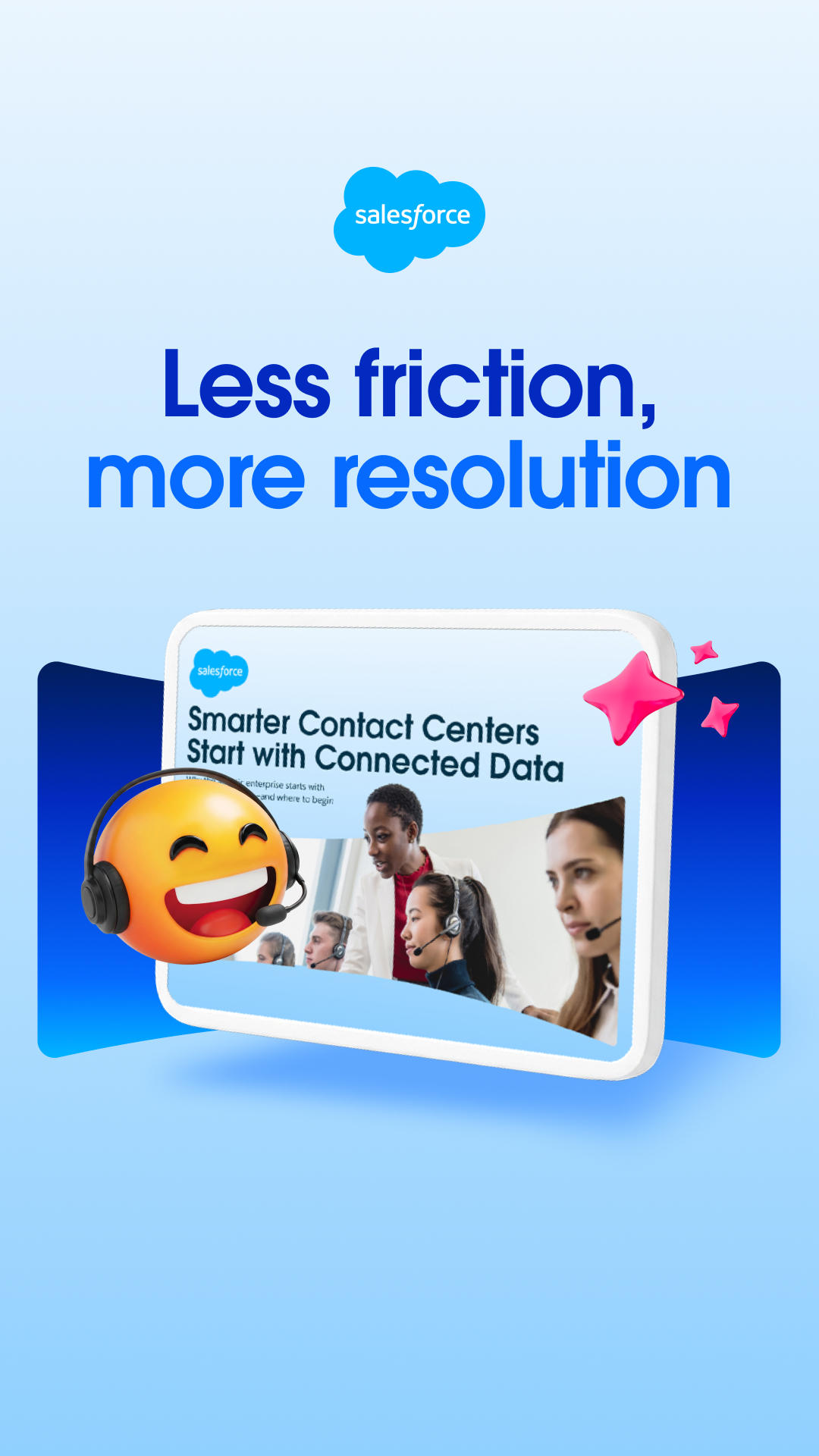
Source: Public Meta ad record 4032064863766233. Format: Static guide ad. Observed promise: A Contact Center Guide about connected data and service resolution. Next step: Download. Source limit: The ad shows an educational resource. It does not independently prove customer outcomes.
This is a good reminder for B2B teams that not every Meta ad should ask for a demo.
A strong guide can be the right next step when the buyer is interested but not ready to speak to sales. The ad works because the asset is narrow: contact centers, connected data and service resolution.
What a B2B Meta agency should borrow:
- Offer a useful resource before asking for a call.
- Put the resource cover or promise in the creative.
- Keep the topic narrow enough that the buyer knows why it matters.
- Use the download to learn about fit, not to declare every downloader qualified.
What Maestro would test from this pattern:
- demand-gen roast checklist,
- Meta readiness scorecard,
- “sales list to ad audience” worksheet,
- follow-up routing based on the buyer’s answers, not just the download event.
6. Salesforce and Live Nation: show the actual use case
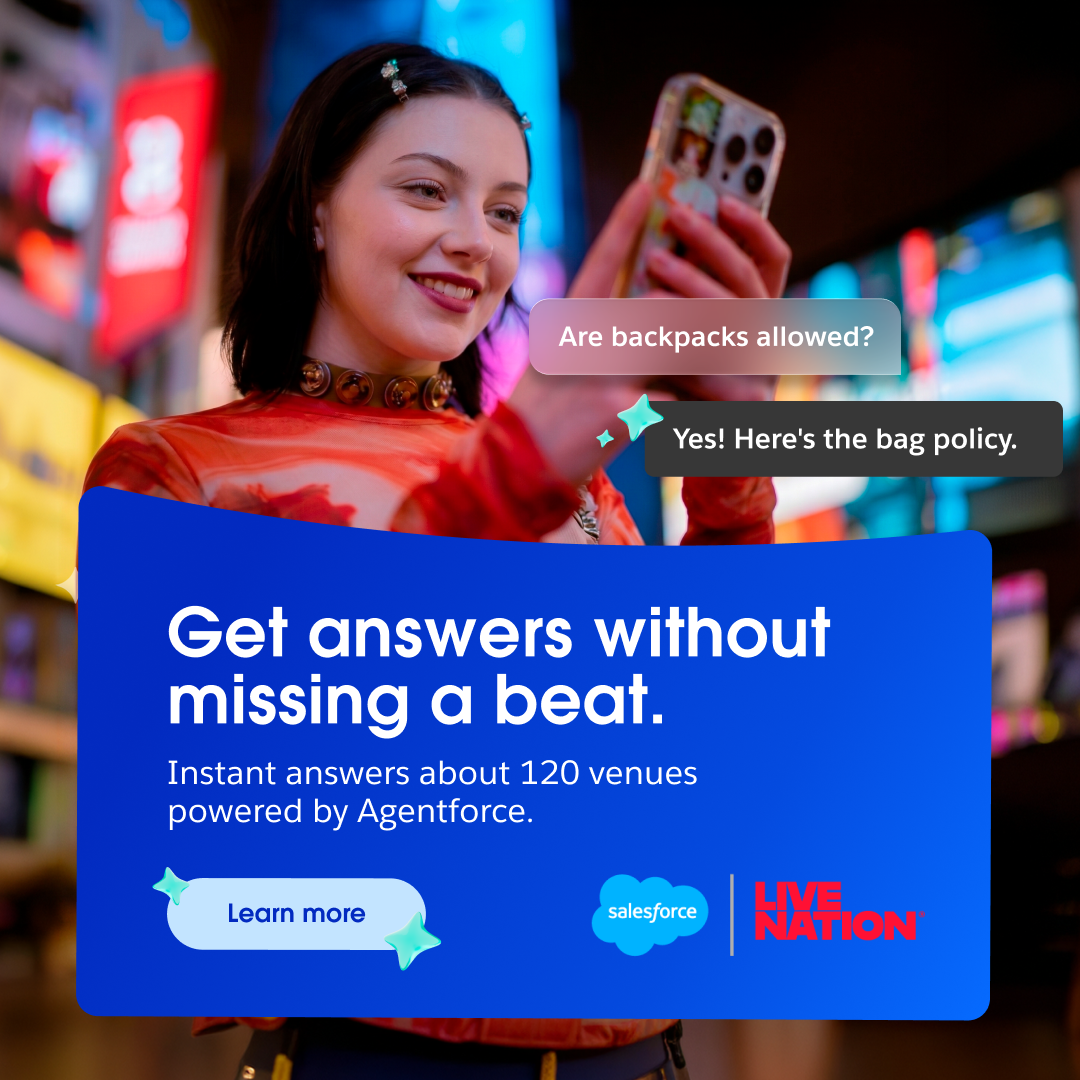
Source: Public Meta ad record 1025567766894244. Format: Static named-use-case image. Observed promise: Agentforce answers venue questions such as bag policies, parking and show times. Next step: Learn more. Source limit: The “120 venues” statement is an advertiser claim in the ad record, not independently audited in this packet.
The ad makes an abstract AI product concrete. It shows a fan asking whether backpacks are allowed and getting a useful answer.
That is much better than saying “AI improves customer experience.”
What a B2B Meta agency should borrow:
- Show one real question the product answers.
- Use a named environment so the viewer can picture the workflow.
- Keep proof claims separate from what the image itself shows.
- Send people to a page that expands the use case.
What Maestro would test from this pattern:
- one-screen product use case ads,
- vertical-specific versions,
- landing sections that answer the same question shown in the ad,
- sales follow-up based on which use case the buyer clicked.
7. Asana: pair practitioner explanation with product overlays
Source: Public Meta ad record 1660648119181191. Format: Creator/product video. Observed pattern: A practitioner explains recognizable work tasks while product overlays show how the work is organized. Source limit: The inspection covered the local video, contact sheet and transcript from the earlier Facebook-for-B2B packet. It does not prove campaign performance.
This pattern is useful when the product is broad but the buyer needs one practical scene.
The person gives the video a reason to watch. The product overlays make the claim less abstract. The ending gives the buyer a named next action.
What a B2B Meta agency should borrow:
- Use a person to explain the job.
- Use product overlays to show how the job changes.
- Keep the video to one main idea.
- Retarget viewers with the specific template, page or workflow shown in the ad.
What Maestro would test from this pattern:
- founder-led explanation with screen overlays,
- short cuts by buyer role,
- landing page with the exact workflow shown,
- landing-page and form events for people who reach the offer after the ad. Keep anonymous video-view reporting aggregated; do not pretend every viewer becomes a known CRM contact.
Go deeper on the part you need
- Facebook ads for B2B explains the campaign choices in more detail and includes a complete campaign-planning worksheet.
- B2B ad examples gives you more creative patterns across recognizable B2B brands.
- B2B landing page examples shows how the ad promise should continue after the click.
What should happen in the first 90 days
A B2B Meta program should not begin with “let’s launch some ads.”
It should begin with the system.
Days 1–15: audit the inputs
The first job is to find out whether the campaign has enough real inputs to work.
We would look at:
- target accounts and contacts,
- customer lists and CRM fields,
- current website and landing pages,
- existing LinkedIn and Meta activity,
- founder or expert content,
- proof and customer material,
- sales follow-up process,
- conversion events and CRM stages.
The output should be a clear call: ready to test, ready after fixes, or not ready yet.
Days 16–30: build the first campaign system
This is where the work becomes concrete.
We would define:
- the first audience,
- the first creative angles,
- the landing page or form path,
- the qualification questions,
- the CRM handoff,
- the reporting view,
- the follow-up owner.
The goal is not to launch a huge campaign. The goal is to launch something that can teach us the right lesson.
Days 31–60: launch and learn from quality
Early data should not be judged only by CPC, CTR or CPL.
Those numbers matter, but they are not the business outcome.
We would look at:
- which audience segments engage,
- which creative earns attention,
- which offer gets the right people to respond,
- which leads sales accepts,
- which accounts show repeat engagement,
- which landing-page questions or drop-offs appear.
If the leads are cheap but irrelevant, that is not success. It is a signal to fix the offer, form, audience or feedback loop.
Days 61–90: scale what creates useful sales conversations
The first 90 days should end with a decision.
Keep scaling if Meta is producing useful engagement, qualified conversations or pipeline learning.
Revise if the right people engage but the offer or page does not convert.
Pause if the audience is too small, the offer is too weak, or sales cannot follow up.
A good agency should be willing to say all three.
What to bring to a free demand gen roast
You do not need a perfect setup before talking to Maestro. But the better the inputs, the more useful the roast.
Bring what you have:
- your best customer list or target account list,
- the buyer roles you care about,
- your current LinkedIn or Meta account structure if available,
- the page or offer you want to promote,
- examples of founder content or sales calls,
- your CRM stages,
- what counts as a qualified meeting,
- what sales says about current lead quality,
- your budget range and timeline.
If you do not have all of this, that is fine. Missing inputs are useful too. They show what has to be fixed before paid media can work.
Use the B2B Meta readiness tools
Start with the worked example if you want to see what a useful answer looks like. Then complete the worksheet and use the review prompt to get a clear launch, fix-first or hold decision.
Download: B2B Meta readiness worksheet
Open the blank worksheet and answer it with your sales, marketing and RevOps owners. If you want a reference, open the worked example first.
You will make eight decisions:
- ICP and sales list readiness.
- Audience size and match assumptions.
- Offer clarity.
- Creative inputs.
- Landing page or instant form path.
- CRM and follow-up owner.
- Qualified-meeting definition.
- Whether to launch, fix the inputs first, or hold.
Do not leave the last line blank. Name the first campaign you would run, the owner of the missing work, or the reason to hold. That turns the worksheet into a decision instead of another checklist.
Copyable prompt: review our B2B Meta readiness
Use this prompt with your own notes before booking a call. It includes the context an agent needs, so it does not depend on this article.
Copy the complete readiness prompt
This includes the questions and output format, so it still works when copied away from this page.
You are helping us decide whether we are ready to test B2B Meta ads. Do not invent benchmarks, case studies, conversion rates or missing facts.

Context:
B2B Meta works best when audience, offer, creative, landing path, qualification and CRM feedback are built together. It is weak when a company treats Facebook and Instagram as cheap lead volume with no quality feedback.

Reference patterns:
- A creator-led CRM ad can work when it names one workflow problem before showing the product.
- A role-specific ad can work when it names the job, consequence and next step.
- A comparison ad needs a real comparison page and should not imply superiority without evidence.
- A guide or worksheet can be a better next step than a demo when the buyer is not ready.
- A named use case is stronger than a generic feature claim.

Our business:
[What we sell, who buys it, deal size and sales cycle if known]

Target market:
[Industries, company sizes, job titles, target-account list or customer list]

Offer:
[Demo, audit, assessment, guide, webinar, trial, consultation, other]

Proof and creative inputs:
[Founder POV, customer story, product screenshots, approved claims, reports, videos]

Landing path:
[Landing page, instant form, calendar page, guide download, homepage, other]

CRM and follow-up:
[CRM, routing, owner, qualification rules, stages, follow-up speed]

Budget and test window:
[Monthly budget range, timeline, what would make us scale / revise / stop]

Return:
1. Strong-fit signals.
2. Weak-fit risks.
3. Missing inputs that would make the test misleading.
4. First campaign angle to test.
5. First offer or landing path to use.
6. CRM feedback needed before scaling.
7. Recommendation: launch now, fix first, or hold.

If a required input is missing, ask for it in a short list and still complete the parts you can judge.
FAQ
Does Meta work for B2B?
Yes, when it is built around the way B2B buyers actually behave.
Meta works best for creating demand, retargeting warm audiences, distributing useful proof, testing creative, promoting lead magnets and reaching target buyers outside the LinkedIn feed.
It works badly when the campaign expects cold buyers to fill out a high-commitment demo form with no trust, no context and no follow-up system.
Should we use instant forms or landing pages?
Use the path that fits the offer.
Instant forms can work for simple resources, event registration, assessments and mobile-first campaigns where fast follow-up is ready.
Landing pages are better when the buyer needs more context, proof, examples, pricing explanation, comparison or qualification before converting.
A B2B form should ask enough to protect sales time. It should not become a procurement questionnaire before the buyer has any trust.
How do we avoid bad leads?
Bad leads usually come from one of four problems:
- the audience is too broad,
- the offer is too shallow,
- the form is too easy,
- the CRM feedback never teaches the campaign what quality means.
Fixing lead quality means fixing the whole path. It is not just a targeting setting.
What should we measure?
Measure platform activity, but do not stop there.
Track:
- spend,
- reach,
- click and view engagement,
- form fills or page conversions,
- fit rate,
- sales-accepted leads,
- qualified meetings,
- opportunities,
- account engagement,
- follow-up speed.
A qualified meeting should mean a real buyer from a relevant company had a conversation that matched your agreed qualification rules. A form fill is not the same thing.
What do the Meta Pixel, Conversions API and CRM each do?
They answer different parts of the measurement problem.
- Meta Pixel: records browser activity such as page views and form completions when the visitor's browser and consent settings allow it.
- CRM source capture: stores the campaign source, form answers, owner and sales stage beside the lead. This is where you learn whether the person became a qualified meeting or opportunity.
- Conversions API for CRM: where the technical and consent setup allows it, sends selected CRM outcomes back to Meta. That gives the platform a better quality signal than a form fill alone.
- Sales feedback: explains why a lead was accepted or rejected. That explanation helps marketing fix the audience, offer, form or follow-up.
None of these creates perfect attribution. Keep the platform report and the CRM record, compare them, and make decisions from the pattern. Do not treat an anonymous video view as a known buyer.
Should we start with retargeting or cold prospecting?
Start with retargeting when you already have enough useful traffic or known audiences to work with: website visitors, content viewers, event registrants, customer lists or unconverted CRM contacts. Give them proof, a narrow guide, a comparison or a lower-commitment next step.
Start with prospecting when you need to create new demand and you already have a clear ICP, a credible offer and creative that can stop the right buyer in a personal feed. A sales list or customer seed is more useful than broad B2B interests alone.
Run both when the budget can support two distinct jobs. Keep the campaigns separate enough to learn whether warm demand or new reach is producing the better sales conversations. If the warm pool is tiny, retargeting alone will run out of useful reach. If the offer and creative are weak, prospecting will only expose that problem faster.
How much budget do we need?
The honest answer depends on audience size, offer, geography, sales cycle, creative volume and what you need to learn.
A tiny test can show whether creative gets attention. It usually cannot prove pipeline.
A serious B2B Meta test needs enough budget and time to test different audiences, messages and conversion paths, then read lead quality from the CRM.
Is Meta better than LinkedIn?
That is the wrong question.
LinkedIn is better for explicit professional targeting. Meta is better for lower-cost reach, creative variety and repeated exposure outside the B2B feed.
Most B2B companies should decide how the two channels work together, not which one wins in the abstract.
When should we not hire a B2B Meta ads agency?
Do not hire an agency yet if:
- you do not know who you sell to,
- you have no clear offer,
- sales cannot follow up,
- you cannot define a qualified lead or meeting,
- you need guaranteed pipeline in a few weeks,
- you only care about cheap CPL,
- you have no useful proof, point of view or product story.
Fix those inputs first. Then paid media has something to amplify.
Get a free demand gen roast
If you want to see whether Meta belongs in your B2B paid media plan, bring your current offer, audience and follow-up process to Maestro.
We will look at the system around the ads: the list, creative, page, form, CRM and sales handoff.
If Meta is a strong fit, we will show you where to start.
If it is not ready yet, we will tell you what has to be fixed first. That is often more useful than launching a weak test and blaming the channel later.