Facebook ad funnel: build the smallest route that fits
A Facebook ad funnel maps an observable buyer action to a message, destination and outcome. Choose Direct for one question, Sequenced for a distinct second question, or Hold when evidence is missing.
One message and destination answer the current buyer question.
fixture-direct-brief · no native account or performance proof.Route-choice workspace
Build the selected route
The selector above loads the same example in the full workspace. Work through the six tasks, record the coherence review, then export the handoff.
Start with one buyer question and the evidence that supports it. Choose the message that answers it and the destination that continues it. Then define what makes the buyer eligible for another message and what stops the route.
Add another message only when the buyer has another question and you can observe a signal that makes the message relevant. A three-layer funnel diagram is no reason to build three stages.
Use this guide to choose Direct, Sequenced or Hold, fill in a route plan and define the measurement contract. The completed records give another person the decisions, evidence and open requests needed to review your plan.
Direct, sequenced or Hold?
Use a direct route when the buyer can understand the problem and offer in one message, the destination completes the promise, and the requested action fits the buying situation.
Use a sequenced route when the buyer needs another question answered before taking the commercial action. Give that question its own message, observable entry signal, exclusion and stop condition.
Choose Hold when a required offer, destination, permission, event definition or CRM outcome is missing or unsupported. Name the missing decision, its owner and the evidence needed to resolve it before you build more ads.
| Decision | Use it when | Minimum proof | Common mistake |
|---|---|---|---|
| Direct | One message and destination can carry the buyer from the current question to a proportionate next step | Approved offer, matching destination, defined site event and CRM outcome | Adding an educational stage because direct response feels too simple |
| Sequenced | The buyer needs a different answer before the commercial action makes sense | Observable entry for every state, different buyer question, exclusions and stop rules | Treating any click or view as proof that the buyer is ready for the next ad |
| Hold | A required fact or control is missing, stale, denied or contradictory | Named owner, reason and exact evidence request | Filling the blank with a best guess so the plan looks complete |
Enter the buyer, offer, destination, evidence, events, permissions and sales outcome in the route-choice workspace. Use its decision, reason and missing-evidence requests to choose what to do next.
A message sequence is not a campaign count
Meta's current technical structure has campaigns, ad sets and ads. Meta says an ad set contains bidding, targeting and budget information. An ad combines an existing ad set with an ad creative.
These definitions locate the delivery controls and creative. They do not require one campaign for each funnel stage.
Plan the buyer route first:
Observed signal → buyer question → message job → offer → destination → next eligible state → stop
Then choose the delivery structure from the controls you need:
- objective and optimization;
- audience eligibility and exclusions;
- budget and bidding;
- geography, placements and schedule;
- testing and reporting that keep the results separable.
Two messages can sometimes run inside one delivery structure. One message may need separate ad sets because the audience rules or optimization differ. Campaign count depends on those delivery needs. Message count depends on the buyer's next question.
Build every route state from the same thirteen fields
Create a state record for each message and fill in all thirteen fields.
| Field | What to record | Failure example |
|---|---|---|
| Entry signal | The exact observed event or approved audience rule | “Warm audience” |
| Buyer question | The question this state should answer | “Needs nurturing” |
| Message job | What the ad must explain or prove | “Middle of funnel content” |
| Offer | The exact thing presented | “Value” |
| Destination | The named page, form, registration or asset | “Website” |
| Next eligible state | The event that makes another message relevant | “Engaged” |
| Exclusions | People who must not enter or remain eligible | “Existing leads” with no source |
| Stop condition | The event or decision that ends this route | “Converted” with no definition |
| Platform event | The event Meta records | Lead with no trigger definition |
| Site event | The action the site records | A page view treated as a completed form |
| CRM outcome | The accepted sales or lifecycle state | “Good lead” with no policy or owner |
| Owner | The person accountable for this state and its decision | “Marketing” with no named decision owner |
| Evidence boundary | What the cited source proves and what remains unknown | A public ad treated as proof of targeting or results |
If a value is Unknown, keep it Unknown. Record the owner, reason and exact request that would resolve it.
Meta's Pixel reference says ViewContent can show that a URL was visited; it does not show what the person saw or did on the page. A platform event named Lead also needs an exact local trigger. Define sales acceptance and qualification separately so your team knows which rule the person passed.
Direct route example: one question, one product action
The public monday.com ad names an HR recruiting problem, says “Recruit Smarter with AI Agents,” uses a Sign up CTA and points to a matching product destination. Those are visible facts. The public record does not reveal the targeting, campaign structure, conversion rate or CRM result.
Use the ad as a direct-route reference: it names the problem and offers a product action at a matching destination. If the buyer already understands the problem, another educational ad may add work without answering a new question.

The fictional route below applies that planning approach to a different B2B business. It does not reconstruct monday.com's campaign.
Buyer: operations director at a B2B service firm Problem: client onboarding requests arrive through email and lose an owner Offer: a live workflow review using the buyer's current handoff Entry: approved prospecting audience; no prior response required Buyer question: can this system show who owns the next onboarding step? Message job: show one request becoming an assigned plan with a due date Destination: workflow-review page with the same example and a request form Exclusions: current customers, open opportunities, prior qualified requests and opted-out contacts Stop: accepted workflow-review request or suppression-source match Platform event: Lead, triggered only after a successful request Site event: workflow_review_requested with a deduplicated event ID CRM outcome: qualified_review only for a company with 20+ employees, the named request losing an owner or due date at least twice per month, and an accepting workflow owner; otherwise review_denied Owner: paid media owns delivery; RevOps owns CRM acceptance and readback
The route is direct because the ad can show the problem, mechanism and next action without requiring a separate lesson first.
Open the completed direct route →
Sequenced route example: education first, proof second
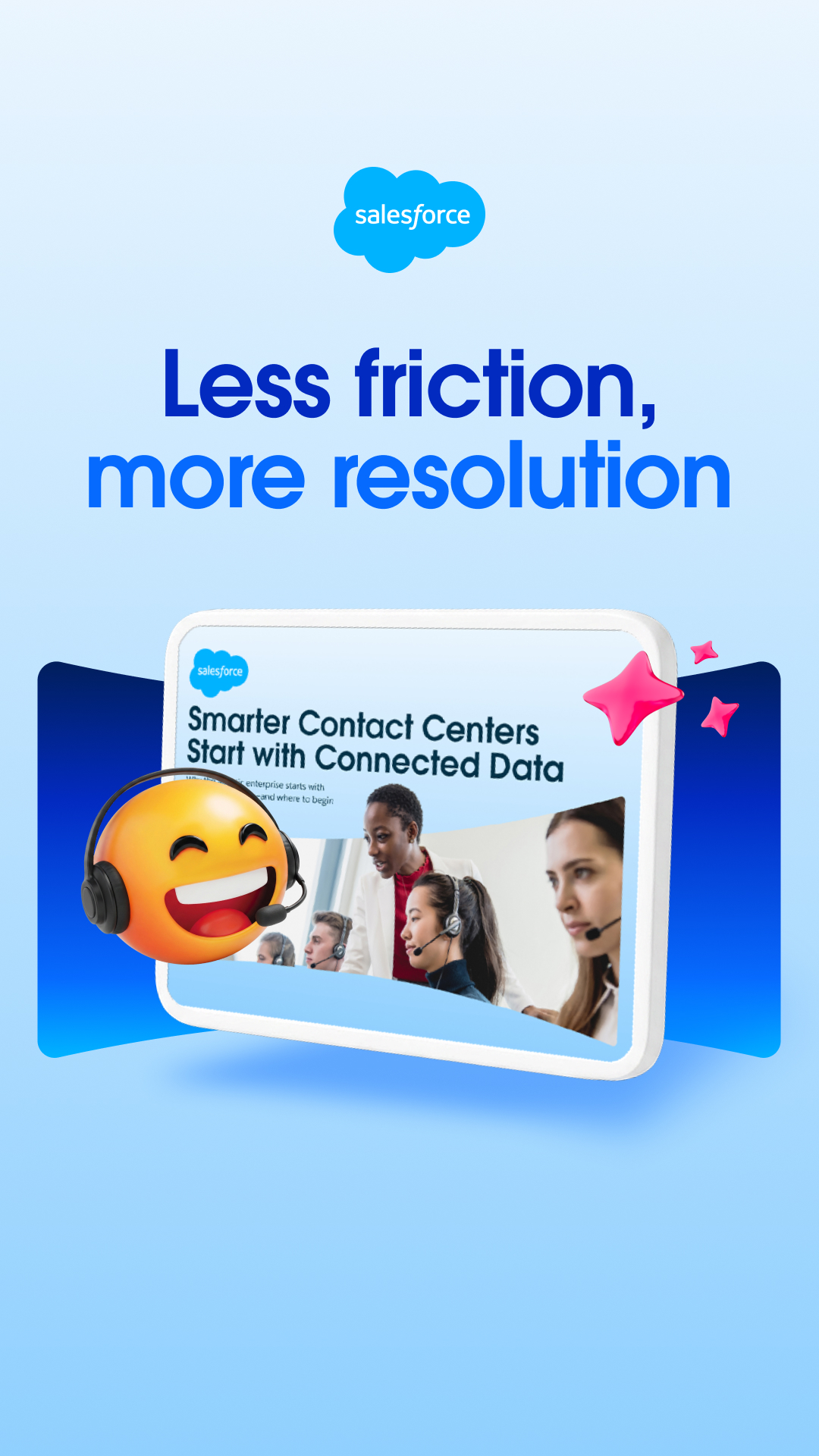
Salesforce's public ad offers a Contact Center Guide through a Download CTA. HubSpot's public ad offers an Ideal Customer Profile report. Both show a specific educational job and destination. Neither public record proves that the advertiser retargeted downloaders or moved them into a private sequence.

A second state belongs in the route when its message answers a different question.
This fictional example uses an educational asset for a finance-software buyer:
State 1: help the buyer diagnose the problem
Entry: approved prospecting audience Buyer question: why do overdue invoices sit without a clear next owner? Message job: show the four points where invoice follow-up loses ownership Offer: overdue-invoice ownership checklist Destination: checklist page with the full resource Next eligible state: verified invoice_checklist_completed only after all four checklist sections are answered and the server accepts version 1, with allowed audience use and a current source receipt Exclusions: current customers, open opportunities, checklist completers when the same acquisition ad would repeat Stop: opted out, suppressed, or accepted for the sales-owned route
State 2: show the operating change
Entry: the approved State 1 event, with a current source receipt Buyer question: what would ownership look like in the actual workflow? Message job: show one overdue invoice becoming an assigned task with a next date Offer: annotated workflow review Destination: review page that continues the exact invoice example Next eligible state: successful review request Exclusions: review requesters, current customers, open opportunities, opt-outs and conflicting sales-owned records Stop: qualified_workflow_review only for a company with 20+ employees, at least 25 overdue invoices per month and a named finance owner; otherwise review_denied. Opt-out, route expiry and offer change also stop the route.
The second message answers a question the first asset creates. That distinct question and the defined entry signal justify the sequence. “Learn” and “book” CTAs alone do not.
Open the completed sequenced route →
Use proof when proof is the next question
UKG's public video uses a named customer who says payroll moved from two days to four hours or less. The preserved destination continues into customer evidence and a contact action. Treat the before-and-after as the customer's attributed statement. The ad does not prove that every buyer will get the same result.
Use a proof message when the buyer needs evidence of credibility, risk or fit. Choose the case study that answers that question.
Everee takes another route. Its short text-led ad presents a pricing mechanism and sends the viewer to a demo page. If pricing mechanics are the buyer's main question, the message can support a direct commercial action.
UKG supplies attributed customer proof. Everee explains a pricing mechanism. Choose the creative job that answers your buyer's question.
Eligibility, exclusions and stop rules
An entry signal tells you what happened. It does not tell you why it happened.
Meta documents website audiences based on visits or specific actions. It also documents engagement audiences and customer-file audiences. The website-audience guide describes excluding current customers. Use those mechanics carefully:
- Name the exact source and action.
- State what the signal proves.
- State what the signal does not prove.
- Record whether the proposed data use is approved.
- Define the people and events that must be excluded.
- Define the stop condition and its owning system.
For a pricing-page visitor, the signal may prove that the browser loaded the pricing URL. It does not prove that the person read the page, understood the price, fits the offer or wants a demo.
For a video viewer, the signal may prove that Meta recorded a selected view threshold. It does not prove agreement with the message or sales readiness.
For a customer-list row, hashing the data does not answer whether the proposed use is permitted. Keep permission and the opt-out process in the route record.
Suppress converted and ineligible people using the freshest approved source available. At minimum, consider:
- current customers;
- open opportunities owned by sales;
- people who completed the next action;
- denied or disqualified records when the policy requires suppression;
- opted-out contacts;
- people covered by a conflicting route.
Define overlap precedence before launch. A person eligible for two messages should not receive contradictory next actions because two audience rules happened to match.
For the full audience and exclusion setup, use the Facebook retargeting ads guide. This page owns the message route; that guide owns detailed warm-audience planning.
Keep platform, site and CRM events separate
Record platform events, site actions and CRM outcomes separately:
| Layer | Example | What it establishes | What it does not establish |
|---|---|---|---|
| Platform | Meta Lead event | Meta received the implemented event under its local trigger | CRM receipt, acceptance, qualification or revenue |
| Site | workflow_review_requested | The site accepted the named action and event ID | Sales accepted the person or held a meeting |
| CRM | qualified_review | The record passed the approved acceptance rule | Meta caused the outcome |
Add the owner, source, join key name, reporting window and attribution limit. Record the key name in the public plan, not a real person's identifier.
Meta describes Conversions API as a connection for website, app, messaging and offline event data from an advertiser's server, platform, app or CRM. Meta's separate CRM guide describes sending down-funnel CRM events back to Meta for the Conversion Leads path and currently ties that path to Instant Forms. Meta also separates its offline-event guidance from that CRM Conversion Leads path.
“CAPI is installed” leaves these questions unanswered. Show what each system recorded, how the records join and which outcome the business accepts.
Open the blank measurement contract → Open the completed fictional measurement contract →
Retargeting is optional, and every route needs an end
In a captured 1000x Leads training Q&A, a webinar attendee asks what should happen after the pitch. The response names continued email, newsletter, community and content follow-up, with retargeting as an option. At 23:03, the speaker gives the stop rule: follow up until the buyer purchases or asks you to stop.
This practitioner example supports two planning decisions; it does not establish a Meta rule:
- Retargeting is one possible channel in a wider follow-up route.
- Follow-up needs a stop condition.
Watch the archived passage from 20:39 →
Your actual stop rule should come from the offer, consent and business process. A purchase, accepted opportunity, completed application, opt-out, disqualification or expired route can each stop a message when the rule and source are defined.
What should each ad link to?
Choose the destination that completes the message job.
| Message job | Destination | Required continuity |
|---|---|---|
| Explain a problem | Focused guide or diagnostic | Same problem, named reader and finished resource |
| Show how the workflow works | Product or workflow page | Same task, visible mechanism and proportionate next action |
| Supply proof | Case study or proof page | Same claim boundary, named source and clear route onward |
| Capture a native lead | Instant Form | Same offer, minimum necessary fields, privacy notice and tested CRM delivery |
| Register for an event | Registration page or form | Same session, date, speaker, promise and attendance follow-up |
| Ask for a conversation | Decision or request page | Same problem and offer, qualification expectations and next step |
Use the detailed guide that owns the implementation:
- Facebook Lead Ads for native forms and CRM delivery.
- Facebook webinar ads for registration, attendance and follow-up.
- B2B lead magnet examples for choosing and producing the asset.
- B2B landing page examples for message and destination continuity.
- Facebook ads for B2B for the broader campaign plan.
Review the route before you build ads
Run these checks in order:
- Is the offer real, approved and complete?
- Does each message answer a named question for a named buying situation?
- Is every eligibility rule tied to an observable source?
- Is the proposed source and data use allowed?
- Does each click continue the same promise at the destination?
- Can converted, ineligible, opted-out and sales-owned records leave the route?
- Which route wins when more than one rule matches?
- Are the platform and site triggers defined precisely?
- Has the owning team defined the accepted CRM outcome?
- Which offer, event, permission or destination change invalidates approval?
- Which account-native receipts are still required before launch?
A complete draft can still be Launch Hold. Before launch, verify that the audience exists, the ad set enforces the intended controls, the site event fires, the form reaches the CRM and the suppression source is current. Keep those facts Unknown until the account, destination and CRM checks supply the evidence.
Download the blank route plan → Copy the standalone route-build prompt → Copy the standalone route-review prompt →
A simple Facebook ad funnel plan
Start with one buyer and work through these steps:
- Name one buyer, one offer and one business outcome.
- Write the buyer question the first ad should answer.
- Decide whether the destination can carry the buyer straight to a proportionate action.
- If yes, plan a direct route.
- If no, name the exact next question and the observable signal that would make another message relevant.
- Add exclusions and a stop condition before adding the second message.
- Define platform, site and CRM events separately.
- Keep launch on Hold for every missing permission, trigger, destination or native receipt. Missing draft-critical facts also keep the draft on Hold.
The completed plan lets a reviewer check each message, transition and stop rule. Add delivery complexity only when the campaign needs it.
If you want another set of eyes on the buyer questions, message sequence, destination and measurement plan, bring the completed route to a free Demand Gen Roast. Maestro can review the route without rebuilding the context from scratch.
FAQ
What are the stages of a Facebook ad funnel?
Use buyer questions and observable states rather than a universal set of stages. A direct route may have one message. A sequenced route needs another state only when the buyer has another question and you can define entry, exclusion and stop rules for it.
Do I need separate campaigns for top, middle and bottom of funnel?
No universal Meta rule requires one campaign per funnel stage. Choose campaigns and ad sets from objective, audience, budget, optimization, testing and measurement needs. Plan the buyer-message route separately.
What should a cold buyer see first?
Show the problem, task or decision they can recognize without prior brand knowledge. Match the offer to what they are ready to do. A clear product action can go direct. A more complex or unfamiliar decision may need education or proof first.
When should I use retargeting?
Use retargeting when an observable action creates context for a different, relevant message and the audience use, exclusions and delivery controls are verified. Do not add it automatically. A direct route may be the better test.
How do I stop people seeing the same ads after they convert?
Define the completion event, refresh the suppression source and exclude converted or sales-owned records from the relevant route. Verify the account-native exclusion before launch. A CRM status written in the plan does nothing until the delivery system actually uses a current approved source.
How do I measure a Facebook ad funnel?
Track delivery and platform events, the site action, CRM acceptance and later commercial outcomes as separate facts. Record the join method and attribution limit. A platform-attributed lead does not by itself prove a qualified opportunity or revenue.