
How to run a B2B marketing audit and decide what to change
A B2B marketing audit should end with a decision, not a longer list of dashboards. Pick one buyer segment and one investment question. Compare what buyers say, what your offer promises, how people find you, what sales receives, and what the team can actually deliver. Then choose a few changes to back, test, or hold. The blank worksheet and completed fictional example let you do the same work outside this page.
You might run this audit when lead volume rises but qualified opportunities do not, when a new segment is being considered, or before renewing a large channel or content investment. A channel report can tell you what happened inside that channel. This audit asks whether the channel, message, offer, handoff, and resources fit the same buyer decision.
1. Name the decision before opening reports
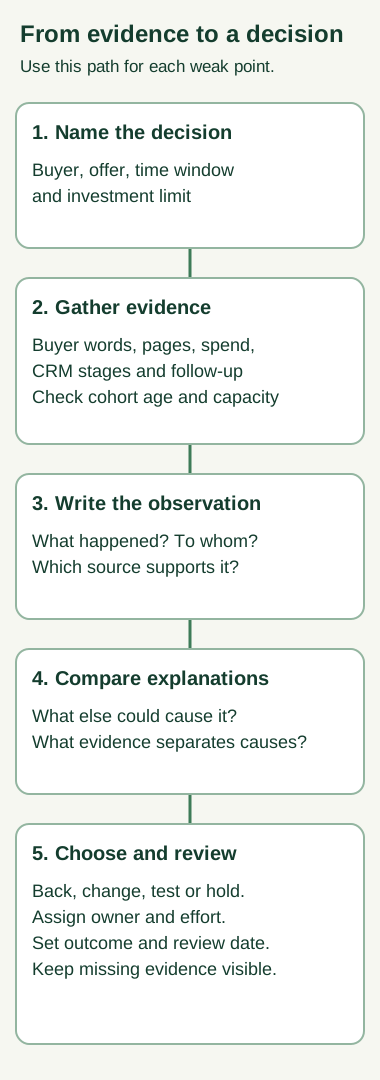
Write down the business question in one sentence: “For [buyer segment] buying [offer], should we back, change, or hold [investment] in [next decision period]?” Name the budget and people available to act on the answer. If two segments buy for different reasons, audit them separately; blended totals can hide the difference.
Choose a historical inquiry cohort and a later observation cutoff that gives those buyers time to progress. Record both dates. For a six-month sales cycle, last week's form submissions cannot be judged by last week's opportunity count. Define what an inquiry, target-fit inquiry, and opportunity mean in your own CRM before calculating rates. If definitions changed during the period, split the analysis or mark the comparison uncertain.
Output: one decision sentence, segment, offer, dates, resource limit, and stage definitions. The worksheet puts these at the top because they govern every later comparison.
2. Assemble evidence that can change the decision
Use a small evidence inventory. A missing item is Unavailable, not zero. A report with broken tagging or unclear definitions is Unreliable until checked. Keep the source, date, and owner beside each observation.
Swipe to read all columns, or focus the table and use the arrow keys.
| Evidence | What to ask | What it can change |
|---|---|---|
| Customers and lost buyers | What job started the search? Which alternative won? What objection delayed the decision? | Segment, offer, proof, and content priorities |
| Current website and sales material | Do the first screen, product page, call invitation, and sales deck describe the same buyer problem and next step? | Positioning and conversion path |
| Channel and content inventory | What was actually published or bought, for whom, at what cost, and with whose time? | Investment choices |
| CRM history | Of the same dated inquiry cohort, who fit the segment, entered each stage, and became an opportunity? | Commercial quality and handoff |
| Follow-up records | Who received each inquiry, when, and with what next action? | Whether an apparent acquisition problem is a response problem |
| Measurement setup | Which site actions are recorded, how are channels assigned, and where do joins fail? | Confidence in every comparison |
Interview a few recent customers and lost buyers, plus sales and customer success. Ask for specific buying situations and objections rather than a general verdict on the brand. Small interviews can expose a mismatch; they cannot establish a market-wide percentage.
In HubSpot's lifecycle documentation, stages can be customized and stage entry dates can be inspected. That makes a same-cohort review possible when the records are sound. A current “Opportunity” count alone is not the conversion rate of last quarter's inquiries. Google Analytics distinguishes key events from Google Ads conversions; a completed form event is still not a sales-qualified opportunity. Search Console's performance report can show search clicks and queries, but those numbers do not tell you who bought.
3. Inspect the marketing system against the chosen buyer
Review each area for a visible observation, a buyer consequence, and a possible action. Skip a channel you do not use; record why it is outside this decision. Do not turn every row into a technical subaudit.
Swipe to read all columns, or focus the table and use the arrow keys.
| Area | Question to answer | Evidence to inspect | Possible decision |
|---|---|---|---|
| Segment and offer | Is the offer solving a problem this segment recognizes now? | Buyer interviews, won/lost notes, proposal objections | Narrow the segment or change the offer claim |
| Positioning and proof | Can a buyer tell what you do, for whom, and why the claim is credible? | Homepage, offer page, proof, sales deck | Rewrite the first screen or gather missing proof |
| Website and next step | Does the page promise the same next step the form and sales team deliver? | Actual landing page, form, confirmation, first sales reply | Repair the promise and handoff |
| Organic content and search | Which buyer questions have answers, and can buyers find them? | Content inventory, Search Console pages/queries, buyer questions | Refresh, combine, or create a specific answer |
| Paid and social | Are the audience, message, destination, and cost aligned with the target segment? | Campaign exports, creative, destination, CRM cohort | Test a narrower message or hold spend |
| Email and events | Do follow-ups answer the objections that appear later in the deal? | Sequences, event invites, attendee follow-up, CRM history | Keep a relevant touch, repair timing, or stop one |
| Measurement and ownership | Can the team trace a contact to a defined outcome, and who acts when a lead arrives? | Stage definitions/history, source tags, assignment and response timestamps | Fix the join or ownership before declaring a winner |
Public pages show how to inspect a buyer path, not whether the company wins from it. On Gong's homepage, captured October 31, 2026, the first screen says “Revenue AI Built To” and cycles through jobs including “Close deals faster” and “Predict pipeline risk”; the visible next actions are “Book a demo” and “See Gong in action.” The demo destination asks visitors to book a demo and describes pipeline visibility and productivity. The platform-tour destination calls itself a self-guided tour and says “You’re one step away from touring Gong!” above a form. The two routes offer different ways to inspect the product. In your audit, record which buyer job each route promises, whether the actual form and follow-up deliver that next step, and which route your chosen segment uses. A route mismatch would be a page finding; matching copy would still need buyer and CRM evidence. These public pages do not show conversion rate or customer fit.
On Ramp's homepage, the first screen says “Time is money. Save both.” and shows “See a demo” and “Get started.” Its demo page offers an expert-run 30-minute tour, a desktop-only interactive tour, and product videos. Its signup page says “Apply for Ramp’s corporate card and all-in-one finance platform” and begins an application. Those are visibly different commitments. If you found a buyer arriving for a quick product look but landing in an application, you would investigate route choice and promise consistency before rewriting the ad. The public pages cannot tell us which route performs better.
For a deeper account-level inspection, use the LinkedIn Ads audit or Facebook Ads audit. For the operating plan after this decision, use the demand generation versus lead generation guide. This audit stays with the cross-business choice.
4. Compare explanations before moving money
A high form count with few opportunities can mean poor audience fit. It can also mean slow follow-up, different stage rules, a missing source join, or simply too little time for the cohort to mature. Write at least two plausible explanations and the evidence that would separate them. Keep an observation distinct from a hypothesis. “120 forms came from paid social” is an observation; “paid social reaches the wrong buyer” is a hypothesis until fit and follow-up are checked.
When records are incomplete, choose a bounded diagnostic action. Do not convert missing timestamps into late responses, or missing opportunity joins into zero opportunities. A “hold” can mean keep a limited program running while the missing evidence is resolved. It need not mean stop all activity.
5. Turn the findings into an investment decision
Here is a complete fictional teaching case. Northstar Maintenance sells maintenance-planning software. It is choosing whether to focus its offer on US manufacturers with 500 to 5,000 employees and at least three plants, or broaden the message to smaller single-site teams. Its first sales call is a workflow review. It also needs to allocate a fixed $35,000 marketing program budget for January–March 2027. The historical cohort is distinct first inquiries from January 1 through June 30, 2026, with opportunities observed through October 15. These company facts and figures are invented for the example, not a Maestro client result.
Swipe to read all columns, or focus the table and use the arrow keys.
| Fictional first channel | Six-month program cost | Inquiries | Target-fit inquiries | Opportunities from the same inquiries |
|---|---|---|---|---|
| Broad paid social | $12,000 | 120 | 18 | 3 |
| Intent search | $8,000 | 40 | 24 | 8 |
| Organic content | $6,000 | 25 | 14 | 5 |
| Trade event | $9,000 | 20 | 12 | 4 |
| Total | $35,000 | 205 | 68 | 20 |
The counts are deduplicated and assigned to each inquiry's first recorded channel. All 20 recorded opportunities are within the declared multi-plant segment because the case defines opportunities as a subset of target-fit inquiries. That definition cannot show whether the segment beats an alternative. The table shows 18 of 120 social inquiries fit it, versus 24 of 40 from search. Across channels, 137 of 205 inquiries are outside that segment. That is a reason to investigate a broader offer, not evidence that those 137 companies are all single-site or worthless. Their size mix and downstream commercial outcomes for a different offer are unknown. The six-month program costs and next-quarter budget have different time windows; the case does not compare their rates or assume each historical spend level is a quarterly run rate. It also does not show closed revenue or causal return.
Six fictional won/lost notes give another clue: four mention multi-plant rollout or integration effort. The fictional homepage says “maintenance software for every team”; the sales deck leads with multi-plant planning. The content library has no answer to the rollout question. This suggests a message and proof gap across channels, but six notes are directional, not a market survey.
There is a competing explanation for paid social's low opportunity count: first-response timestamps are missing for 37 of its 120 inquiries, compared with 2 of 40 search inquiries. Missing timestamps do not prove slow follow-up. Sales operations should inspect assignments and activity history before the team blames targeting or moves the entire $12,000. Stage definitions and source tags also need a spot check.
Northstar's fictional strategic choice is to focus the next-quarter offer on multi-plant manufacturers and keep the workflow review as the first call. A general single-site expansion is held, not rejected: the 137 outside-segment inquiries lack the buyer and commercial evidence needed to justify a second offer, and the product marketer has limited capacity. The product marketer will use four hours of existing November time to interview a small outside-segment sample by November 20, 2026, before reconsidering expansion. The separate 20 January hours and $3,000 January–March test budget fund the rollout page and follow-up work. The provisional focus follows the current offer and sales material, buyer questions about multi-plant rollout, and limited capacity. The opportunity count cannot compare segments under the case's definition.
The resulting budget choice is to back search and content provisionally, change the paid-social message in a bounded test, and hold a larger shift until the follow-up records are reconciled. For January–March, plan $8,000 for intent search, $6,000 for content, and $9,000 for the trade event; cap broad paid social at $9,000; use the remaining $3,000 for the rollout-question page and follow-up test. That totals $35,000 as a new plan, not a time-normalized comparison with six-month costs. These are owner-selected planning ceilings inside the fixed budget, not amounts calculated from historical returns. Event continuation is conditional: its fictional cohort includes 12 target-fit inquiries and 4 opportunities, but the team must check attendee follow-up before committing the event amount on December 1, 2026. If that evidence fails, the allocation meeting must reassign the $9,000. The product marketer has 20 hours in January for the page and follow-up; the November interviews use four existing hours outside this budget. No new hire is assumed.
Swipe to read all columns, or focus the table and use the arrow keys.
| Priority | Action and reason | Owner and resource | Review trigger and outcome |
|---|---|---|---|
| 1. Repair evidence | Reconcile the 39 missing response timestamps and spot-check source/stage definitions before treating differences as channel effects. | Sales operations partner and demand generation lead; existing time | By December 1, report resolved records and revised comparison. If still unreliable, keep the larger channel shift on hold. |
| 2. Choose the offer | Keep the multi-plant workflow-review offer, interview a small buyer sample in November, then publish one page that states the rollout process and what the call covers. Hold a separate single-site offer until that evidence is read. | Product marketer; four existing November hours for interviews, then 20 January hours plus the $3,000 January–March test budget for page and follow-up | Interview readout November 20; page target January 31. Continue if interviews support the chosen buyer job; revise if another job dominates; keep expansion on hold if outside-segment evidence is thin. |
| 3. Bound the paid test | Cap broad social at $9,000 next quarter and test the specific multi-plant message against the current one with matched destination and stage definitions. | Demand generation lead | April 30: inspect fit and follow-up. October 15: compare opportunities from the January–March cohort. Continue only if fit and defined outcomes support it; otherwise revise or stop. |
The first action has high confidence because the missing timestamps are a direct record-quality observation. The focus on the multi-plant offer has medium confidence because the current offer, buyer notes, and live message point to a specific job, but the outside-segment opportunity has not been assessed. The claim that paid social itself is weak remains low confidence until follow-up and definitions are checked. These are judgments for this invented case, not universal scores.
Download the audit and run it on your business
Run the audit with your own evidence
Start with the blank worksheet and compare the filled fictional example. Copy the complete prompt with your own facts. You can also open the plain-text prompt.
Read or select the full prompt
Start with the completed fictional audit to see how each finding becomes a decision. Copy the blank audit worksheet and replace every fictional field with your own source and date. If you want help organizing your notes, use the standalone audit prompt. It asks for missing essentials and leaves unknown outcomes unknown; the prompt is not a substitute for verifying your records.
Bring the decision sentence, source inventory, and biggest unresolved explanation to a Demand Gen Roast if you want a second set of eyes on the investment choice. The roast is a separate Maestro service; the downloads above are the self-service audit.
How this guide was built
The audit scope and interview prompts draw on the TripleDart B2B marketing audit guide, while Upland's strategy audit is a source for stage and ownership questions. The evidence distinctions use the official HubSpot, Google Analytics, and Search Console documentation linked above. Gong and Ramp are public page observations captured October 31, 2026. Their visible copy and routes are examples of what to inspect, not evidence of commercial performance. The Northstar example, all its numbers, and its decisions are fictional.