
ABM platform buyer's guide
Account-based marketing platforms: choose software your team can run
Start with a buyer situation
See what blocks the shortlist
Choose a fictional record. The same evaluator used by the downloads applies Must-have blockers before it shows the Should-have score.
Open the full decision record ↓Loading the Cedarline fictional fixture.
- Should-have score
- —
- Evidence complete
- —
An account-based marketing platform helps a team choose target companies, understand activity at those companies, coordinate outreach and see what happened afterward. Some products cover much of that work. Others solve one part, such as account data or advertising. The right choice depends on the part your current systems cannot do, the people who will run it and the evidence you need before buying.
Start with the job, not a vendor list. Write down your current CRM, data sources, ad destinations and owners. Mark each new requirement Must-have, Should-have or Excluded. Then compare products against dated evidence. A product with an unanswered privacy requirement does not become a good fit because it scores well on features.
The ABM platform evaluation workspace below turns those decisions into a requirements record, blockers, questions and a validation plan. You can also download the runnable evaluation bundle and work outside this page. Two fictional buying situations show what the record looks like for a small team and a larger one.
On this page
What should the platform do for your team?
If your immediate task is to reach a sales account list, map the account-based advertising workflow before choosing software. If the gap is execution capacity, the agency scope guide helps separate the work you need delivered from the account and sales decisions your team owns.
Account-based marketing starts with a selected group of companies and coordinated work to win them. Software can help with several parts of that work: connecting account records, finding signals, reaching people, changing their experience, routing tasks and reviewing outcomes. Buying a broad system does not remove the need to decide who owns each part.
Write one sentence about the failure you need to fix. “We need ABM” does not give a vendor a testable question. “Our sales team cannot see which target accounts engaged with the campaign, and no one owns the CRM update” does. The second sentence points to a data flow, an owner and an acceptance test.
| If the problem is… | Look at this layer first | Ask the product to show… |
|---|---|---|
| Account and contact records are incomplete or hard to join | Data and enrichment | Where records come from, how an account match is made, permitted uses and how corrections reach your CRM |
| The team needs a reason to prioritize one account now | Intent and signals | The source, time window and meaning of a signal, plus false-positive review on your own accounts |
| The selected accounts are known, but reaching them is difficult | Activation and account-based advertising | Audience construction, exclusions, delivery reporting and a trace from your source list to the destination |
| The same page or message needs to change by account or segment | Personalization | The rule that changes the experience, its fallback and who maintains each version |
| Sales and marketing lose track of the next action | Orchestration | What starts a task, who receives it, how it is resolved and what writes back to the system of record |
| Reports disagree or stop at clicks | Measurement | Definitions, identity rules, source data, suppression or modeling limits and CRM reconciliation |
| Several of these gaps belong in one operating workflow | All-in-one platform | The exact modules needed, the flow between them, implementation work and the boundaries of the package |
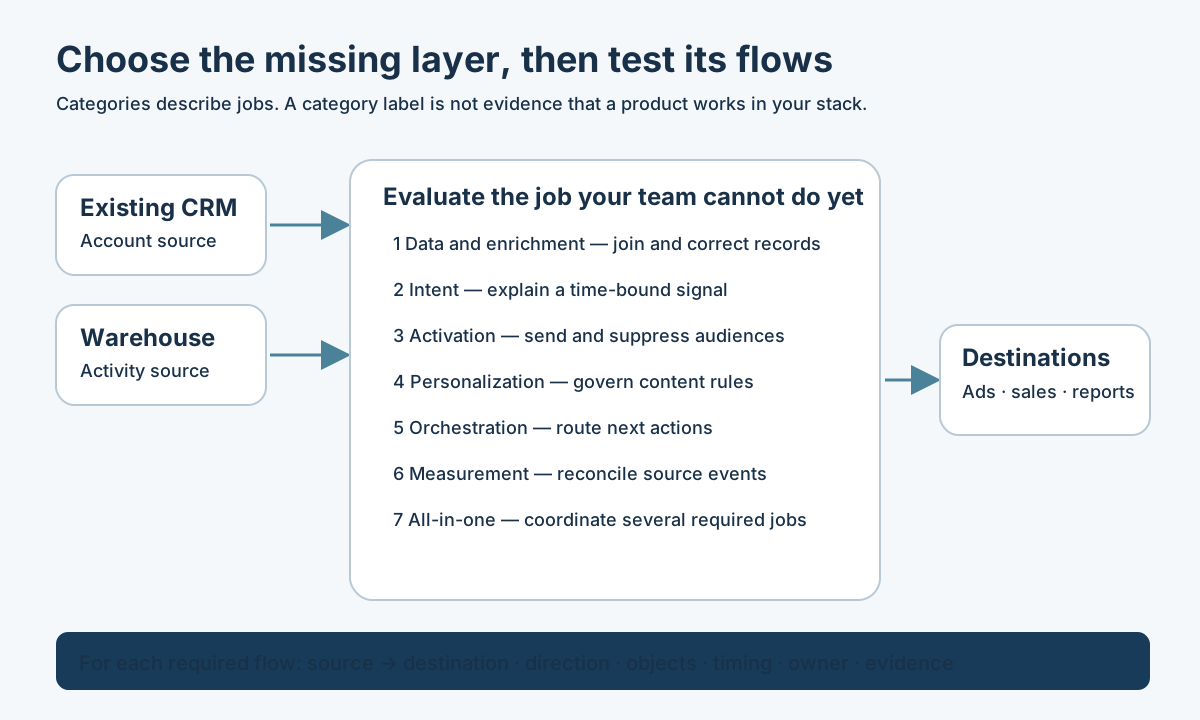
Categories overlap. An advertising platform can report engagement. A CRM can coordinate sales tasks. An all-in-one vendor may sell several modules. Category labels help you decide what to inspect; they do not prove that a product meets a requirement. If your CRM already does the handoff reliably, write that down before paying for another handoff screen.
All-in-one or one missing layer?
Choose a narrow layer when the rest of the workflow has named owners and works well enough. The test is whether that addition can send the right fields to the systems people already use. Choose a broader evaluation when gaps cross several layers and your team has the capacity to implement and govern a shared system. In either case, name what you would retire, connect or keep. An extra platform that duplicates the CRM without changing the work can add another place for account status to disagree.
Sometimes the right decision is to do the operating work first. If no one owns the target-account definition, adding intent data will not decide which accounts sales should pursue. If no one can maintain the customer exclusion, another ad platform will not keep it current. Put that owner and process into the requirements record before a demo.
Recognizable products, with the limits of public evidence
These examples show different places software can sit in an ABM stack. They are category examples, not a ranking or a shortlist for your business. The first-party pages below were checked on 7 October 2026. They show what each vendor says its product family does; they do not establish the connector behavior, coverage, security terms, current price or results your team would get.
| Product example | Where it may fit | What the dated first-party page supports | What your team still has to verify |
|---|---|---|---|
| Demandbase | A broad account-based platform spanning data and identity, intent, advertising and orchestration | Demandbase describes those product areas and integrations on its product page | Your account and contact coverage, signal provenance, exact modules, connector direction, governance, implementation work and commercial terms |
| HubSpot ABM software | ABM work inside a CRM and marketing product family | HubSpot presents ABM capabilities within that product family | Which functions are in your package, required data flows, user permissions, operating effort and price |
| RollWorks | Account-based advertising with related orchestration | RollWorks presents an account-based platform with advertising and orchestration capabilities | Audience construction, destination behavior, CRM fields, integration work, service scope and cost for your use |
| LinkedIn Campaign Manager | One advertising destination | LinkedIn documents its ads products and campaign tools | How your account list reaches LinkedIn, who owns it, what comes back to your CRM and whether the rest of your ABM workflow needs another system |
LinkedIn is in this table because it is easy to confuse an activation destination with the whole operating system. You can run ads there without buying a separate all-in-one platform, but Campaign Manager does not by itself define your sales process, CRM source of truth and cross-channel decision rules. If LinkedIn is the selected channel, use the LinkedIn ABM campaign planner after the software decision. That guide handles account-list readiness, audience route, message, offer and CRM checkpoints for the campaign.
An intent-data category belongs in your comparison if prioritization is the actual gap. We verified a broad Demandbase example for this page. We did not verify specialist coverage from inaccessible public Bombora and 6sense pages, so the table does not imply that named providers have equal data or coverage.
Make the existing stack visible before comparing products
Draw the path a target account follows today. For each system, record what it is authoritative for. The CRM may own account and opportunity status; a warehouse may hold product activity; marketing automation may own email permissions; an ad account may own delivery events. Your team decides the source of truth for each field. A vendor's “integrates with your CRM” statement does not answer which way data moves.
For every required connection, record:
| Field | Question to answer |
|---|---|
| Source and destination | Which two systems exchange information? |
| Direction | Is the flow into the new platform, out of it or both? |
| Objects and fields | Which account, contact, campaign, consent, task or opportunity fields move? |
| Timing | How often does the flow run, and how late may data arrive? |
| Write-back | What changes in the system of record, and can a person correct it? |
| Failure handling | Who sees failed syncs, duplicates and rejected records? |
| Owner | Who configures, monitors and approves the flow? |
Suppose your CRM is the account source and a proposed activation tool uses its target-account list. “CRM integration” could mean a one-way nightly audience export, a bidirectional sync of account and engagement fields, or a manual file handoff. Those are different designs. Ask the vendor to trace one test account through the specific route you need and show what happens when its owner or exclusion changes.
Also name the humans. Who builds segments? Who approves data use and regional handling? Who writes creative, fixes sync errors, reviews sales feedback and reads the report each week? A feature that requires an unassigned operator is an unresolved requirement, even if the feature appears on a product page.
Turn goals into requirements a demo can prove
A Must-have is a condition without which the product cannot do this job. A Should-have is valuable but negotiable. An Excluded requirement marks work or burden the team has decided it will not accept. Give each requirement a stable ID, an owner and a test. Reuse that ID across products and exports so the question stays the same even if the wording changes.
| Requirement type | Example for a CRM-to-ad workflow | Acceptance test |
|---|---|---|
| Must-have: integration | Selected target accounts and customer exclusions reach the activation destination | Move a buyer-controlled account fixture from the CRM, change one exclusion and inspect the destination plus error log |
| Must-have: privacy and security | The proposed data flow meets the team's data-use and access rules | Have the data/privacy owner review the vendor's current terms, controls and exact fields in the proposed flow |
| Must-have: ownership | A person can run and monitor the connection after launch | Name the implementation and operating owners; show their tasks and access in a handoff |
| Should-have: workflow | Sales can see a concise account-activity summary in its existing workspace | Show an example account with source and time window; have a sales owner confirm it helps a real review |
| Excluded: operating load | The team will not maintain a separate manual customer-exclusion file | Demonstrate a maintained route, or record a conflict if the file is unavoidable |
Capability is only one kind of requirement. Include data coverage, integration, security and privacy, service, implementation and cost where they affect the decision. If a legal or regional requirement is mandatory, make it a Must-have with the relevant owner. Do not hide it inside a weighted feature score.
Use the same requirement row for every candidate. A blank cell is not a quiet pass. The evaluation workspace requires one coverage cell per requirement per product. That makes omissions visible when a polished demo has answered a different question from the one your team asked.
Record what you know, and how you know it
The evidence label describes how far a claim has been checked. A dated product page can establish that the vendor documents a capability. It cannot prove your data will match, a sync will work in your account or a service team will implement it on your schedule.
| Evidence state | What it means | What to do next |
|---|---|---|
| Documented | A dated first-party source states the capability | Test the exact use case and package if it matters to the decision |
| Vendor claim | A sales page or overview says the product can do it | Ask for the configuration, limits and evidence behind the claim |
| Demo observed | A named reviewer saw a relevant action in a dated demo | Repeat it with your fields or a controlled fixture |
| Buyer tested | Your team ran a defined test and recorded the result | Keep the input, expected result and observed output |
| Unknown | The answer was sought but no usable evidence was supplied | Give an owner a precise question and keep the decision open |
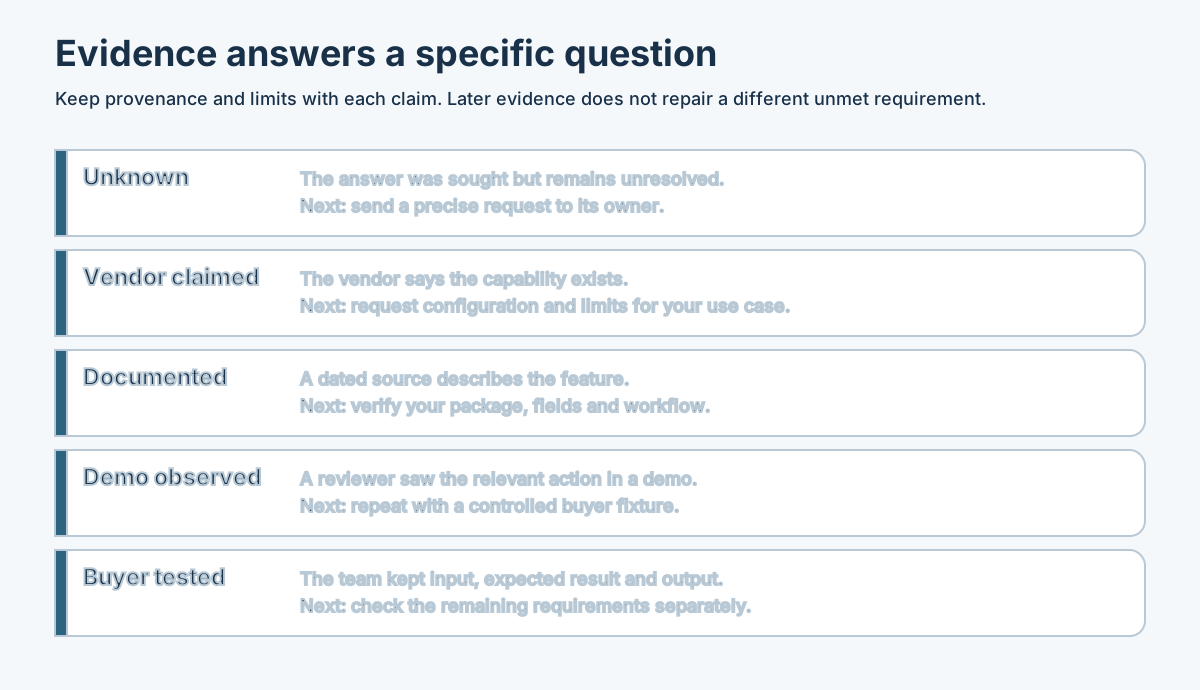
Missing means your team has not supplied the fact. Unknown means someone looked or asked, but the answer is unresolved. Known zero is an actual measured or quoted zero with its source. Not applicable needs a reason tied to the requirement; a product cannot exempt itself from a Must-have. Conflicting or invalid facts need correction. Two products with Unknown data coverage are not equally good at coverage. They are both unverified.
For account data and intent, ask where each field or signal came from, when it was observed, what population it covers, how it joins to your account IDs and what a false positive would look like. Test a sample of accounts your team knows. For activation, inspect the actual audience route, exclusions and delivery record. For personalization, check the rule, fallback, permissions and who updates it. For measurement, trace an event from its source to a CRM action and keep reported engagement separate from a qualified opportunity. A dashboard total cannot establish that software caused pipeline.
Security and privacy deserve their own evidence request. Ask about the exact data sent, permitted use, access controls, retention, regional handling, subprocessors, deletion and incident process as they apply to your proposed flow. Your data/privacy owner should decide which documents and tests satisfy the requirement. A general trust-page link may be a starting point; it is not a signed answer to every use case.
Build a shortlist you can defend
The workspace starts with your buyer job, categories, systems, owners, requirements and candidate products. Add dated evidence for each product, then evaluate. It shows the product disposition, blockers, open requests, Should-have score and evidence completeness together. It also keeps the current record if an imported replacement is invalid.
Canonical evaluation workspace
Inspect, edit, validate and export the record
Load a complete or blocked example, or start from the blank record. Edit the JSON, then run the canonical evaluator. Invalid imports keep the last accepted record.
Source record
Loading the Cedarline example…
Decision
Blockers
Open requests
Accepted fingerprint: None
The score is deliberately narrow. It adds the weighted Should-have requirements that have resolved evidence. It excludes Must-haves and Excluded requirements. Show the score beside the share of Should-have weight with resolved evidence. A 100% score on three answered questions is not the same record as a 100% score on ten. Neither score cancels a failed Must-have.
The evaluator routes a product to Blocked when a Must-have fails or remains unresolved, a required category or integration is missing, a privacy or ownership condition is open, or an excluded burden is unavoidable. A product with all Must-haves met but remaining nonblocking work goes to Validate. It reaches Shortlist ready only when those requirements are met and no product request remains. These are rules for the evaluation record, not a claim that the software has been independently certified.
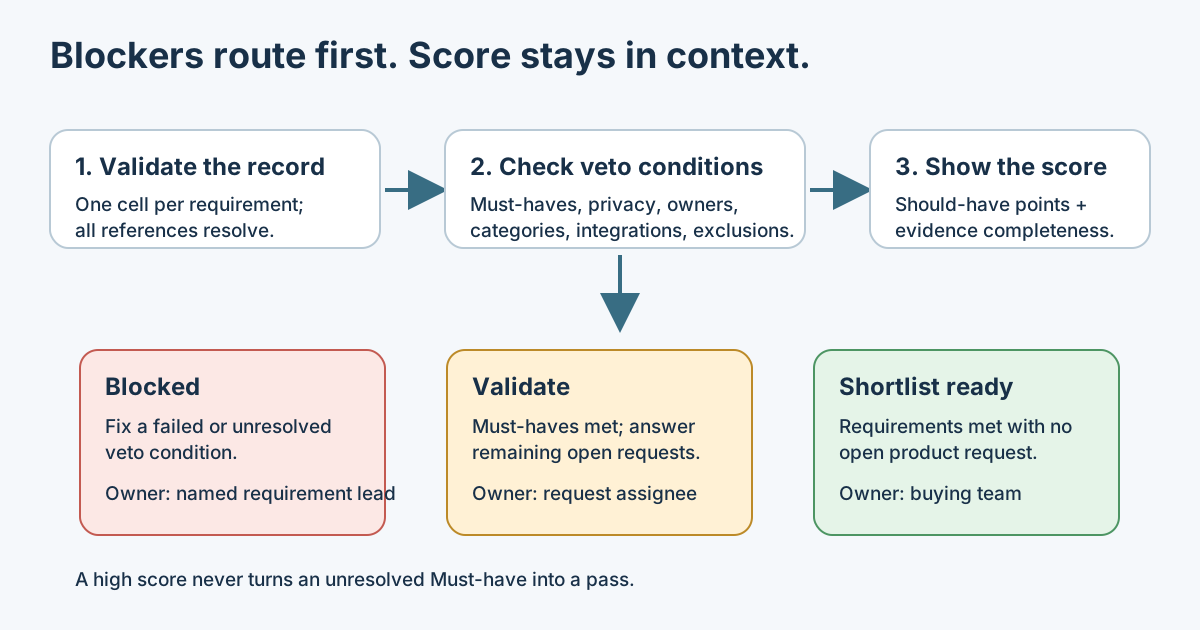
If the team cannot use the browser workspace, open the blank evaluation record and runnable bundle. The build prompt helps turn supplied facts into the record. The review prompt runs the same evaluator to check it. Both prompts are designed to work outside this article with the bundle. Missing input stays Missing or Unknown and produces a question; a prompt should never guess a price, connector or test result.
A small team buying one missing layer
Consider Cedarline, a fictional B2B software company. Its sales team has a CRM account list, and two marketers already run paid media. They can name the accounts they want to reach. Their immediate gap is a governed route from CRM account membership and suppression state into an advertising destination. They are evaluating a narrow activation layer without replacing the CRM. Cedarline, its products, accounts and decisions in this example are invented teaching inputs, not Maestro or client results.
Cedarline records the CRM as the source of truth for account membership and suppression, the advertising platform as the source of truth for delivery status and RevOps as the implementation owner. Its data/privacy lead owns the permitted field map and deletion process. The required flow moves account ID and suppression state from the CRM to the advertising destination each day. The current CRM stays in place.
| Cedarline requirement | Priority | Proof needed |
|---|---|---|
| Sync the CRM account list to activation | Must-have | Reconcile five synthetic account IDs and their suppression states at the destination |
| Meet the proposed advertising data-use rules | Must-have | Data/privacy owner approves a dated field map and deletion process |
| Assign a named implementation owner | Must-have | Owner accepts setup, monitoring and failure handling |
| Avoid a second manual list to maintain | Excluded burden | Show how the list stays current or record a conflict |
| Support native paid-media activation | Should-have | Create a synthetic destination audience without changing a live campaign |
Imagine Candidate A documents a CRM connector, but Cedarline has not tested suppression handling or completed privacy review. At that stage, the record holds those Must-haves as Unknown and routes A to Blocked. RevOps owns the sync test, and the data/privacy lead owns the document review. Candidate B can create an audience but requires a separate manual list that Cedarline has excluded. The evaluator records that conflict instead of adding feature points and recommending B. Cedarline's next action is a controlled CRM-to-destination test and a privacy review, not a purchase decision.
The loaded Cedarline fixture shows the later state after fictional candidate RelaySignal has passed those tests. It reaches Shortlist ready with no open request. Use the Missing inputs fixture to inspect the unresolved state instead. These are separate stages of the teaching example, not competing descriptions of one current record.
This gate can keep a small team from buying a large implementation project. The narrow layer may be enough if its specific flow works and the owners can maintain it. If no candidate can pass that test, the team can repair its existing CRM process or reconsider the category. A longer vendor list would not answer either question.
A larger team deciding whether one system should coordinate several layers
Northstar Components is another fictional buyer. It sells across several regions and uses a CRM, marketing automation, a warehouse and more than one advertising destination. Its marketing and sales teams want one account view and a controlled route from selected accounts to activation, sales tasks and opportunity review. Unlike Cedarline, Northstar must evaluate several layers together: identity, orchestration, activation and measurement. A regional data/privacy owner and an implementation owner both have veto responsibilities.
Northstar writes separate flows for warehouse-to-platform account attributes, CRM-to-platform opportunity and exclusion status, and platform-to-CRM engagement or task records. Each flow names fields, direction, timing, owner and failure handling. It also records which team may change an account's stage. “Two-way CRM sync” is not an adequate answer when one direction may overwrite the field another team owns.
| Northstar requirement | Priority | Acceptance test |
|---|---|---|
| Keep regional account data within the approved use and access rules | Must-have, privacy/security | Review current terms and run the proposed regional field flow with the data/privacy owner |
| Preserve CRM ownership of opportunity status | Must-have, integration | Change an opportunity in a test CRM; inspect the platform and verify no unauthorized write-back |
| Route a qualified account signal to the assigned seller | Must-have, ownership | Use a test account and show trigger, recipient, audit trail and completed action |
| Compare account activity with CRM progress | Should-have | Reconcile a sample period, including missing and duplicate company rows |
| Let multiple teams work from one account view | Should-have | Have a marketer and seller perform their own tasks on the same test account |
Suppose Candidate C meets every answered Should-have and earns 100% on that limited weighted set. In a separate, deliberately narrow Northstar activation-layer test, however, the required data-use condition is not met. C remains Blocked. The 100% score, blocked button loads only that veto test; it is not Northstar's complete multi-system record. The Enterprise button loads the later complete OrbitGrid record after its fictional Must-haves and handoff have passed.
A product with passed Must-haves and only nonblocking integration or commercial work can route to Validate. If integration direction is itself a Must-have and remains Unknown, the product stays Blocked. The score cannot decide either case.
The separate Candidate C fixture names its privacy blocker and owner. The complete Northstar fixture shows the later OrbitGrid handoff after its fictional requirements passed. A real buying team should keep each candidate's package, price, blockers and tests in its own current record. That gives the meeting a better agenda than “C has more features.”
Make the demo answer your requirements
Send the vendor your acceptance tests before the call. Ask them to use a buyer-controlled sample when possible, or to identify where the demo environment differs from your setup. Record who saw the action and when. Keep a product-page statement, an observed demo and a buyer-run test as separate evidence rows.
Demandbase's first-party platform overview contains three passages worth turning into demo questions. It is a vendor-authored, high-level 2024 video, not a live configuration demonstration. The passages describe ideas to test; they do not verify current data accuracy, connector behavior, security, pricing or outcomes.
- 01:30–01:49, signal provenance and buying groups. The narration discusses insights from several data sources and buying-group prioritization. Ask: “For one account in our test set, show the source and timestamp behind each signal, how the buying-group members were identified, and how we can challenge an incorrect fit or weak signal.”
- 02:03–02:22, work across roles. The overview describes advertiser, marketer and seller experiences. Ask: “Move the same test account through those three roles. What can each person see or change, which action is automated, and what event enters measurement?”
- 02:28–03:00, the existing stack. The video describes integrations and APIs. Ask: “For each system we plan to connect, show the objects and fields, sync direction, timing, write-back, errors and work our team must do. Trace one record through the route.”
Vendor overview, used as a question source
Watch the passage, then make the vendor show the work
These links open Demandbase's first-party Brightcove player. The 2024 overview is not a live configuration demo. Stop at the visible end time and use the question beside it.
For any vendor, finish the demo by asking what did not work, what configuration it required and who will maintain it. Then turn a promising demonstration into a dated buyer test. A screen share can show a route; it cannot prove that the route will work with your records, permissions and regional rules.
Compare price and implementation on the same footing
Ask for the scope of the quote before comparing amounts: modules, seats, account or contact limits, data or intent usage, advertising commitments, regions, support, implementation services, renewal terms and overage rules. Record billing period and usage basis alongside the amount. A per-seat fee and a usage-based data fee cannot be added or normalized fairly without your expected usage and the buyer's commercial model.
If a vendor does not publish the price you need, enter Unknown and request a dated quote. Do not turn it into zero or borrow a figure from a review site. A verified zero implementation fee is different from an unpublished fee. Price Unknown blocks a decision when an approved cost ceiling is a Must-have that requires a comparable total. Otherwise it remains an open commercial request and lowers the evidence completeness of the comparison.
Implementation has its own cost even when the quote is clear. Name who will map fields, test identity rules, review privacy, build audiences, train users, watch sync failures and reconcile reports. Ask what the vendor does, what your team does and what an external partner would do. If those owners are missing, a lower license price has not settled the operating decision.
Take the decision record to the next meeting
A defensible shortlist contains the buyer job; current systems and sources of truth; required categories; all Must-have, Should-have and Excluded rows; one coverage cell per product and requirement; dated evidence and its limits; directional integrations; owners; blockers; open questions; price basis; validation steps and the current route. Keep a record even when the answer is Hold. It tells the team exactly what to ask next.
Use the workspace buttons to download the currently accepted record as JSON, Markdown or CSV. The JSON and Markdown carry that same source record and recomputed decision; the CSV is for review, not reimport. The static Cedarline JSON example, Cedarline Markdown example and Cedarline audit CSV always remain Cedarline examples, even after you load or import another buyer. Download the runnable bundle when the team needs to work offline or use the standalone build and review prompts. Give the next owner the workspace export for the active buyer, not a screenshot of a score or a static example.
If the selected route is LinkedIn advertising, continue with the LinkedIn account-based marketing guide to plan the account list, audience, message, offer and CRM review. A shortlist-ready product still needs its implementation and campaign plan. If the software evaluation exposes a weak account strategy or an unclear sales handoff, fix that operating question before buying more software.
If you want another set of eyes on the platform choice and the campaign it must support, book a free Demand Gen Roast. Bring the current decision record, the blockers and the questions you want answered. We can review the failed Must-haves, evidence gaps and next tests together.
Questions buyers ask before choosing an ABM platform
What is the difference between an ABM platform and an ABM tool?
“Platform” often describes a broader set of connected workflows. “Tool” may refer to one layer. Those are market labels, not a guarantee of scope. Compare the work the product must perform, the package you would buy and the data flows you would operate.
Do we need intent data to start ABM?
No universal software layer is mandatory. If your team has a small, well-researched account list and a clear sales reason to pursue it, it can plan account work without buying intent data first. If prioritization is the gap, define the decision a signal should change and test the source, timing and account coverage of the proposed data.
Can a CRM be our ABM system?
A CRM can be the source of truth for accounts, owners, opportunities and sales actions. Whether it covers the rest of the job depends on your campaign destinations, data and workflow needs. HubSpot is one recognizable CRM-native example; its current first-party page is a starting point for a package-specific test, not proof that your existing license covers every requirement.
Which integrations matter most?
The ones required to carry your account decision and response back to the owner. Map source, destination, direction, objects, timing, write-back and failure handling. Start with the CRM and the activation destination you will actually use, then add the warehouse, marketing automation and analytics routes that change a decision.
What if every vendor has an Unknown price or feature?
Keep the Unknowns visible. Send the same dated evidence request to each relevant vendor and assign an owner to compare the replies. Equal Unknown values do not establish equal capability or price. If a Must-have remains unresolved, the product stays Blocked until the evidence arrives.
Should we choose the highest weighted score?
Only among products that have passed the blocking requirements, and only after checking which Should-have questions were answered. The score measures supplied requirement coverage. It does not verify data quality, security, adoption or pipeline impact. Read the blocker list and evidence completeness beside it.
What should we do if no product reaches the shortlist?
Read the generated requests. A missing owner calls for an internal decision; an unanswered connector question calls for a demo or test; a failed privacy requirement calls for another design or candidate. A Hold result can be the right buying decision when evidence is incomplete.
Sources and example notes
Product examples above use Demandbase, HubSpot, RollWorks and LinkedIn first-party pages checked 7 October 2026. They show vendor-described product areas, not independently tested fit. The Demandbase video is a vendor overview uploaded in 2024; the three passages guide demo questions. Cedarline, Northstar and all candidate dispositions in the worked situations are fictional. The evaluation rules on this page are Maestro's disclosed worksheet rules, not vendor ratings or a universal industry standard.