
Facebook bid strategies: choose the control that matches your result
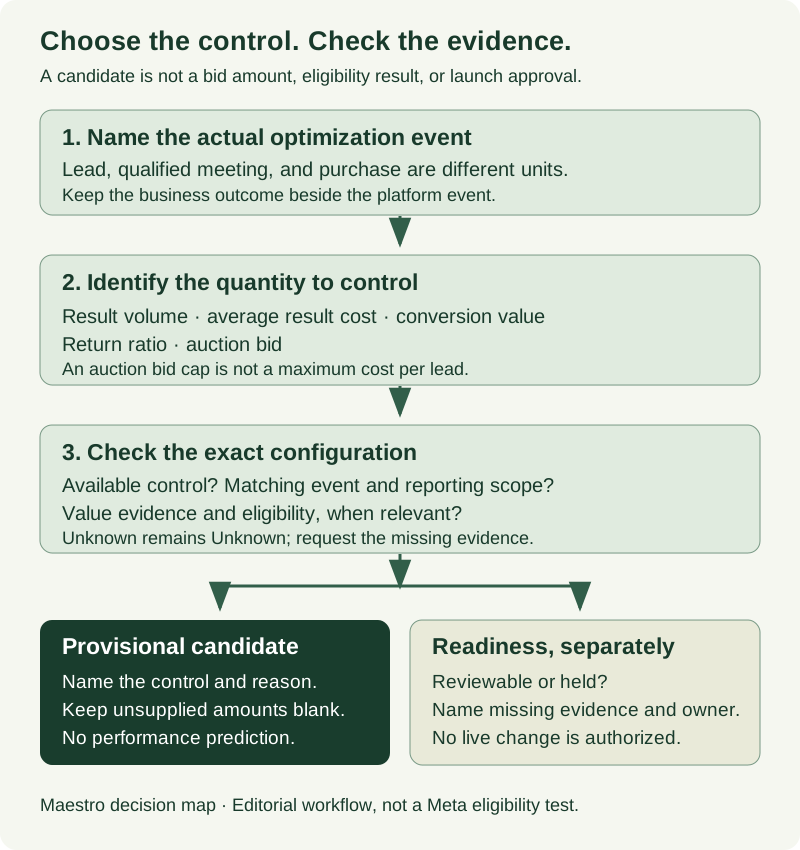
Choose a Facebook bid strategy by naming the result Meta is optimizing for, deciding whether you need a cost or value goal, and checking which controls are available for that configuration. A cost per result goal guides the average cost of the selected result. A bid cap limits the bid in an auction. They do different jobs.
For a B2B campaign, start with the event. A form submission, a qualified meeting, and a purchase are different outcomes. A target that makes sense for one can be badly wrong for another.
This guide helps you prepare a bid-control decision and the evidence needed to review it. It does not select a bid amount or forecast what your campaign will deliver.
Download the bid decision worksheet and work through one campaign. You can also download the review prompt to review a completed record. If you are still deciding what to change, begin with the Facebook ad optimization guide.
What each Facebook bid strategy controls
Ads Manager labels and Marketing API names differ. The table uses the familiar Ads Manager labels described in Jon Loomer's guide and separates them from the mechanisms in Meta's bid-strategy documentation. Confirm the options displayed for your actual objective, conversion location, and performance goal.
| Control | What you are asking Meta to do | What the control does not establish |
|---|---|---|
| Highest volume | Seek as many optimized results as possible from the budget, without an added cost or bid cap. | An acceptable cost per qualified lead, or a fixed cost for each result. |
| Cost per result goal | Seek results while working toward an average cost target. | A guaranteed maximum cost for every result, or guaranteed full budget delivery. |
| Highest value | Use value optimization to prioritize conversion value. | That your account is eligible, that values are reliable, or that reported value equals profit. |
| ROAS goal | Apply a return goal to a value-optimization setup. | Guaranteed return, or permission to treat a lead's expected pipeline as a completed purchase. |
| Bid cap | Set the maximum bid Meta can use in auctions. | A maximum reported cost per lead or a guarantee of delivery. |
Meta's API uses LOWEST_COST_WITHOUT_CAP, COST_CAP, LOWEST_COST_WITH_MIN_ROAS, and LOWEST_COST_WITH_BID_CAP. Highest value is a value-optimization use of the uncapped strategy, rather than a fifth API strategy enum. This naming difference is one reason older instructions can look inconsistent with Ads Manager.
The API documentation says cost-cap adherence is not guaranteed. It also warns that cost and bid constraints can leave budget unspent. Treat those tradeoffs as part of the decision, rather than assuming that adding a control makes every result cheaper.
Name the result before choosing the control
Write down the current campaign objective, conversion location, performance goal, and event. Copy the actual names from the campaign. Then name the business outcome you use to judge it. Record the attribution setting and whether reports group results by impression date or conversion date. Keep those definitions fixed when comparing periods.
For example:
- Meta optimization event: completed website Lead.
- Business outcome: sales-accepted demo.
- Relationship: a CRM record connects a submitted lead to its later qualification decision.
Those fields explain what a cost target means. If Meta is optimizing for Lead, an average cost per Lead is the relevant platform unit. Your sales-accepted-demo cost remains a separate business measure.
A fictional example: $40 per lead is not $200 per qualified meeting
Suppose a campaign spent $4,000 and produced 100 platform leads during a defined period. The same mature cohort contains 20 qualified meetings in the CRM.
The platform cost per lead is $40. The business cost per qualified meeting is $200. Both calculations are correct. The $40 figure counts submitted leads; the $200 figure counts qualified meetings.
If the campaign still optimizes for the initial Lead event, typing $200 into a cost per result goal does not ask Meta to deliver qualified meetings at $200. It expresses a target for the selected platform result. A lower $40 goal would not guarantee the same qualification rate either.
Record the downstream qualification measure beside the platform baseline. If you want Meta to optimize for a later event, first verify that a suitable conversion route and performance goal are available and correctly implemented. A bidding change does not create that route.
Use the Facebook reporting template to keep delivery and CRM outcomes tied to the same cohort. If the join is missing, resolve that gap before presenting a qualified-lead target as an observed platform cost.
Check eligibility before recommending an option
Public documentation explains what a control does. The account determines which options are available for your configuration.
In the worksheet, record these details before selecting a candidate:
| Detail | What to record |
|---|---|
| Campaign and ad set | Stable references and account currency. |
| Current optimization | Objective, conversion location, performance goal, and event. |
| Current bidding | Exact label, any entered goal or cap, and whether the setting belongs to the campaign or ad set. |
| Budget ownership | Campaign budget or ad-set budget, amount, and schedule. |
| Available options | The options shown for this configuration, with a dated screenshot or authorized readback. |
| Value readiness | Whether value optimization is available and whether the actual conversion values are being received correctly. |
Use Unknown when an option has not been checked. Use Unavailable only when the actual configuration shows it unavailable or a current, applicable requirement rules it out. Neither state means the account is broken.
Meta's API bid-strategy page requires VALUE optimization and account eligibility for minimum-ROAS bidding. It also describes compatibility conditions for cost-cap bidding. These are reasons to check eligibility, not a reason to assume that every campaign exposes every control.
The same documentation includes legacy objective labels. Do not copy that old objective table into a current configuration without checking the current supported mapping. For this decision worksheet, the operator records the available control rather than guessing it from an article.
Choose a candidate from the constraint you actually have
A candidate is an option to review. It is not a promise that the option will outperform your current setup.
You need an initial result-cost baseline
If the campaign is eligible and you have not established a comparable baseline, an uncapped volume strategy is a candidate to evaluate. Jon Loomer recommends the default volume approach as the starting point for many campaigns. That is practitioner guidance, not a rule that every account must follow.
Set the test budget and business guardrails separately. An uncapped bid strategy does not remove the campaign budget, and a campaign budget does not guarantee an acceptable cost per result.
Do not manufacture a cost goal from an industry average. Your event, audience, offer, conversion lag, and measurement quality determine whether a historical result is comparable.
You have a defined average cost target for the same event
A cost per result goal is a candidate when the constraint is an average platform-result cost and you can tolerate reduced delivery while pursuing it.
Record the target's origin. Is it a business requirement, an observed cost, or an untested ambition? An observed cost describes what happened; a business requirement describes what the campaign needs to achieve. They may disagree.
If the business needs $30 leads but comparable delivery has produced $60 leads, do not hide the gap by calling $30 a validated starting value. The worksheet should show the conflict and the cost/volume tradeoff that needs review.
You are optimizing genuine conversion value
Highest value and ROAS-goal strategies belong to a value-optimization decision. Record the event values, their currency, their meaning, and the evidence that the selected setup supports them.
For a B2B team, a CRM estimate of future contract value is not automatically the same thing as a purchase value sent to Meta. Verify the supported event and value route before using that estimate in a configuration.
ROAS is supported conversion value divided by ad spend for a matched currency and reporting scope. For example, $8,000 in observed purchase value divided by $4,000 spend is 2x ROAS, or 200%. That is revenue relative to ad spend, before costs and margin. An estimated $8,000 in possible future contracts does not establish that purchase return.
An unconstrained value approach and a return goal also answer different questions. One prioritizes value within the budget; the other introduces a return constraint. A demanding return goal can reduce delivery. Neither proves incremental revenue or profit.
You specifically need to limit the auction bid
A bid cap is a candidate only when the intended constraint is the auction bid and an operator can explain and monitor that decision.
Do not copy a cost per lead into a bid-cap field simply because both are currency amounts. Meta's documentation explicitly distinguishes the bid from the cost shown in reporting. A bid cap can reduce eligible auction wins and leave budget unspent.
If the reason for choosing bid cap is “I never want a lead to cost more than $50,” stop at that misunderstanding. The field does not enforce that business rule.
Work through three decisions
These examples are fictional. They illustrate the record, not expected results.
1. New lead campaign with no comparable history
The campaign optimizes for a website Lead. The team has a fixed pilot budget but no observed cost per Lead for this offer. Highest volume is displayed as available; the cost goal is blank.
Candidate: evaluate the uncapped volume approach within the approved pilot budget. Keep the proposed cost goal blank. Record the business cost limit separately, the review date, the event evidence, and the downstream quality measure.
This produces a baseline plan. It does not declare that spending the budget will produce enough events or that every lead will qualify.
2. Established campaign with a lower-cost requirement
The mature cohort has $4,000 spend and 100 Leads. The business now requires $30 per Lead. A cost per result goal is available, and the owner is willing to accept fewer leads while testing the constraint.
Candidate: review a cost-goal test. The observed baseline is $40 and the required target is $30. Preserve both. Do not label the target proven or choose a new cap automatically.
The review must define how much reduced delivery is acceptable and when the outcome will be evaluated. The business may discover that the constraint cannot be met with the current offer and audience.
3. A lead campaign requesting a ROAS goal
The team optimizes for completed forms and has estimated potential contract value in its CRM. No value-optimization eligibility or supported value-event receipt has been supplied.
Decision: hold the ROAS-goal recommendation. Ask the measurement owner to identify the intended event, document its value semantics, and confirm the actual available performance goal. Keep the current campaign setting unchanged while reviewing that question.
The missing evidence is specific. It is not a request to collect every account metric before making progress.
If delivery falls, inspect the configuration before relaxing the goal
A low spend total does not tell you which constraint is responsible. Read the current status, schedule, budget, audience, selected event, available conversion evidence, and entered control together.
Start with a comparison to the last known configuration. Record what changed and when. If creative, audience, budget, and bidding all changed, the result does not isolate bidding.
Ask whether the control is stricter than the evidence supports. Then check other visible reasons for limited delivery. Do not automatically increase the bid, raise the cost target, broaden the audience, and replace the creative in one repair.
Meta's pacing documentation separates budget pacing from bidding and identifies low bids or narrow targeting as possible contributors to underdelivery. These are diagnostic possibilities, not a diagnosis of your campaign.
Record missing observations as Unknown. An absent result can mean zero events, an incomplete export, or an event that has not matured yet. Those cases need different next steps.
Turn the decision into a reviewable change
Complete the worksheet with the current control, proposed candidate, reason, and open eligibility checks. If an amount is proposed, keep its currency, result unit, source, and owner attached.
Before a live change, define the fixed variables, the observation window, the business guardrails, and the review date. Keep a record of the exact previous value so the implementation can be checked afterward.
Then use the optimization experiment brief for the change itself. The bid worksheet chooses what to investigate; the experiment brief defines how you will judge a controlled change.
A completed worksheet should let another operator answer four questions: What result are we buying? Which constraint are we considering? Is that control available here? What evidence will tell us whether the tradeoff is acceptable?
Review your worksheet
Open the completed fictional example to see how to preserve a promising candidate while holding an incomplete change. Then complete the blank worksheet for your own campaign.
Paste your completed worksheet after the prompt below. Remove private account references and customer details first. Check the answer against your evidence: the strategy candidate and permission to change a campaign are separate decisions.
Copy the bid strategy review prompt
Copy this prompt into your AI tool, then supply your completed bid worksheet and configuration evidence. The complete text is also available as a TXT download.
Read or select the full prompt
Sources and limits
Mechanics were checked against Meta's bidding overview, bid-strategy reference, and pacing documentation. Familiar interface labels and practitioner context were compared with Jon Loomer and Flighted.
The public Business Help pages did not expose their full current content during this review. No campaign was edited or tested for this guide. Verify the exact labels and availability in the configuration you intend to use.